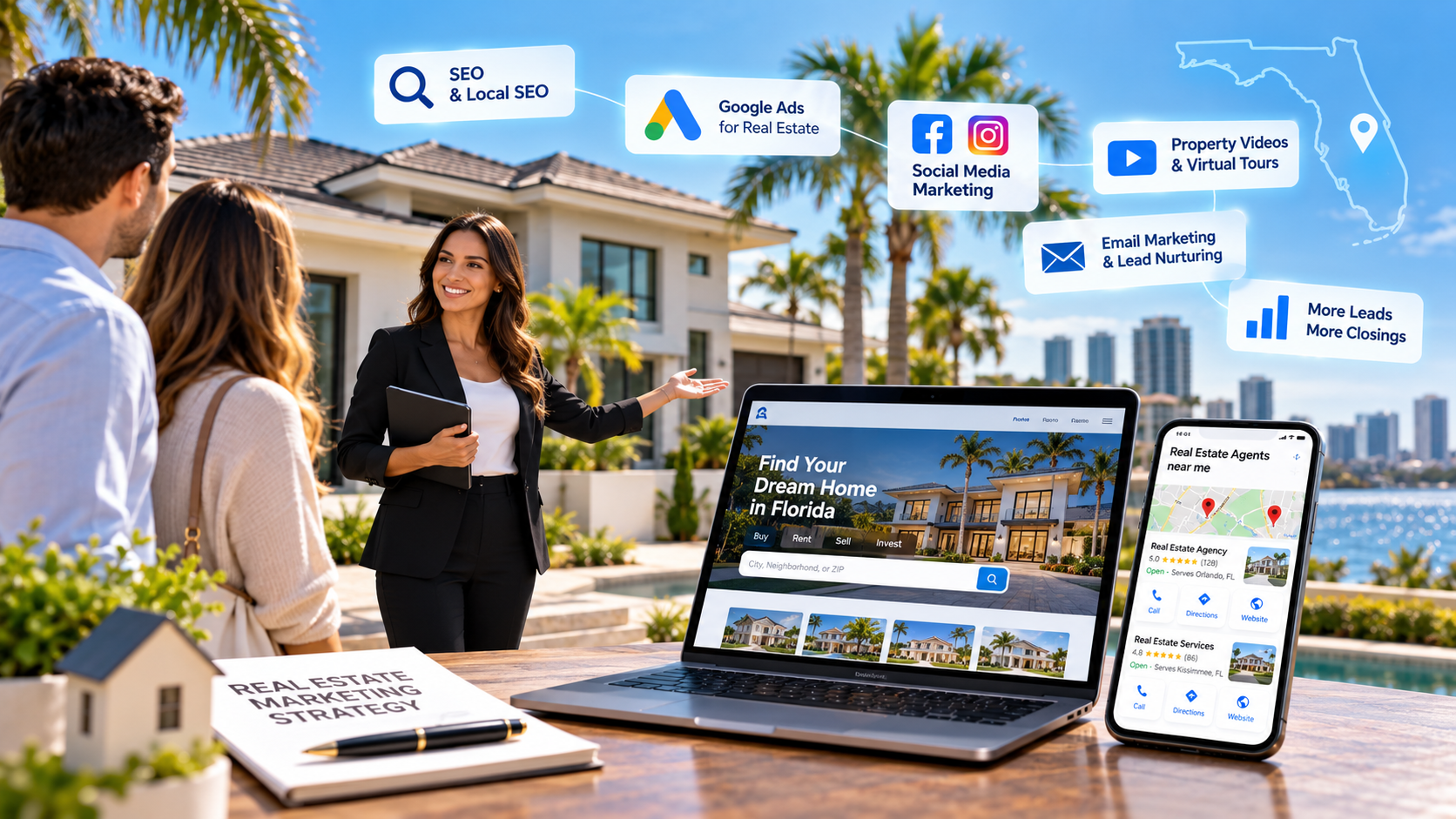
Generating consistent property enquiries is one of the biggest challenges for real estate agents, brokers, and agencies in Florida. Whether you are promoting residential properties, helping clients buy or sell homes, or working with property investors, reaching the right audience online is essential for growing your business.
Today’s property buyers and sellers often begin their journey by searching online. They compare properties, explore neighborhoods, review real estate agents, and research local market information before deciding whom to contact.
This makes digital marketing an important part of real estate lead generation in Florida. A well-planned strategy can help your business appear in relevant searches, showcase property listings, build trust, and turn website visitors into genuine enquiries.
However, simply publishing property listings or posting on social media is not enough. Real estate businesses need a combination of search engine optimization (SEO), local SEO, Google Ads, social media marketing, website optimization, and useful content to attract potential clients.
In this guide, we explore 10 practical digital marketing strategies that Florida real estate agents and agencies can use to improve online visibility and generate more qualified property leads.
1. Build an SEO-Friendly Real Estate Website
Your website is one of the most important digital assets for your real estate business. It gives potential buyers and sellers a place to explore your services, view property listings, understand your experience, and contact your team.
A well-designed website should do more than display property photographs. It should make it easy for visitors to find relevant information and take the next step.
Important website elements include:
- Property Listing Pages: Display available properties with clear photographs, pricing, descriptions, and relevant details.
- Property Search Functionality: Allow visitors to explore listings by location, property type, price range, and other useful criteria.
- Dedicated Service Pages: Create separate sections for buyer representation, seller services, property investment assistance, and other services you provide.
- Mobile-Friendly Design: Ensure visitors can browse listings and submit enquiries easily from smartphones.
- Clear Calls to Action: Include options such as Schedule a Property Viewing, Request Property Details, and Contact an Agent.
- Fast Loading Speed: Optimize images, scripts, and website elements to provide a smooth browsing experience.
Your website should also include useful information about your business, contact details, service areas, and customer experiences.
A professional, user-friendly website can help establish credibility and create more opportunities to convert visitors into potential clients.
2. Use Local SEO to Reach Buyers and Sellers
Real estate searches are closely connected to location. People looking for properties or professional assistance usually search within specific cities, neighborhoods, or communities.
For example, potential clients may search for:
- Real estate agents in Orlando, FL
- Homes for sale in Kissimmee, FL
- Real estate agencies in Lakeland, FL
- Property listings in Winter Haven, FL
- Real estate agents in Clermont, FL
- Homes for sale in Sanford, FL
Local SEO helps your real estate business become more visible when people search for relevant services in your target areas.
Ways to improve local SEO for real estate businesses:
- Optimize your website pages for relevant city and service-related keywords.
- Create and maintain an accurate Google Business Profile.
- Include consistent business information across relevant online directories.
- Publish useful content about the locations and communities you serve.
- Encourage genuine reviews from clients and respond professionally.
- Add relevant internal links between your main service pages, location pages, and educational content.
Your local SEO strategy should reflect the areas where your business actually operates. Relevant location information and useful local content are more valuable than simply repeating city names throughout your website.
3. Create Location-Specific Real Estate Landing Pages
If your agency serves multiple Florida markets, one general service page may not answer the needs of every local audience.
Location-specific landing pages allow you to explain your services in relation to the communities you serve. They also provide an opportunity to address local property interests, customer requirements, and relevant market information.
For example, a real estate business targeting Orlando and Kissimmee may need separate pages that explain its services and local knowledge in each market.
A useful location-specific page should include:
- Real estate services available in the particular area.
- Relevant property categories and customer requirements.
- Useful neighborhood or community information.
- Original property photographs and relevant visuals.
- Genuine local customer testimonials, where available.
- Clear contact information and enquiry options.
Avoid creating multiple pages that only replace one city name with another. Each page should provide meaningful information that helps visitors understand your services in that location.
For example, businesses targeting Orlando and Kissimmee can use location-focused marketing to connect their services with the search needs of different local audiences.
4. Generate Qualified Enquiries Through Google Ads
Search engine optimization helps real estate websites build organic visibility over time. Google Ads offers another way to reach people searching for relevant property services and real estate professionals.
For agents and agencies, paid search campaigns can promote specific services, property-related offerings, and location-focused landing pages.
Examples of relevant search themes include:
- Real estate agent near me
- Real estate agency in Orlando
- Homes for sale in Lakeland
- Property listings in Winter Haven
- Real estate services in Melbourne
To improve campaign performance:
- Organize campaigns around relevant services and locations.
- Select keywords that match the searcher’s intent.
- Write clear advertisements that accurately describe your services.
- Direct visitors to relevant landing pages rather than unrelated website sections.
- Track calls, enquiry forms, and other meaningful conversions.
- Review search terms and exclude irrelevant traffic.
- Monitor lead quality and advertising costs.
Real estate advertising is subject to housing-related advertising policies. Follow applicable Google Ads requirements and avoid discriminatory targeting or messaging.
The objective should be to generate relevant enquiries from people interested in your real estate services, not simply to increase website clicks.
5. Use Facebook and Instagram Marketing to Promote Properties
Real estate is a highly visual industry. Property photographs, walkthrough videos, neighborhood highlights, and agent introductions can help potential clients understand what your business offers.
Facebook and Instagram provide opportunities to showcase listings, share useful information, and maintain relationships with people interested in buying or selling property.
Real estate social media content ideas include:
- New property listings and featured homes.
- Short property walkthrough videos.
- Residential property features and amenities.
- Neighborhood and community highlights.
- Home-buying and selling tips.
- Agent introductions and team activities.
- Genuine customer testimonials.
- Frequently asked real estate questions.
A consistent content schedule helps keep your business visible and gives potential clients useful reasons to engage with your brand.
You can also use paid social campaigns to promote property-related content and generate enquiries. Housing-related advertising must comply with the platform’s special advertising requirements, including applicable restrictions on audience targeting.
Focus on creating informative, visually appealing content rather than publishing promotional posts without a clear purpose.
6. Create Property Videos and Virtual Tours
Property photographs are essential for online listings, but videos can provide a more detailed view of a property and help potential buyers understand its layout and features.
Video marketing gives real estate agents an opportunity to present properties, introduce neighborhoods, and explain services in a more engaging format.
Video content ideas for real estate businesses:
- Property Walkthroughs: Show the layout, rooms, design, and important features of available properties.
- Short Property Reels: Highlight selected features through short-form video content.
- Neighborhood Guides: Introduce relevant community features, local amenities, and surroundings.
- Agent Introduction Videos: Help potential clients understand your services and approach.
- Educational Videos: Explain common steps involved in buying or selling property.
- Virtual Property Tours: Allow prospective buyers to explore properties remotely.
For example, a property walkthrough can show the entrance, living area, kitchen, bedrooms, outdoor spaces, and other important features in a logical sequence.
Publish videos on your website and relevant social media channels. Use descriptive titles and captions, and include a clear way for interested viewers to request additional property information.
7. Build Trust Through Customer Reviews and Testimonials
Choosing a real estate agent is an important decision for buyers and sellers. Potential clients often want to understand an agent’s communication, professionalism, experience, and approach before making contact.
Genuine customer reviews can help establish credibility and give potential clients more confidence in your business.
Ways to strengthen your online reputation:
- Request honest feedback from clients after completed transactions.
- Make it convenient for customers to leave reviews.
- Respond professionally to positive and negative feedback.
- Display genuine testimonials on relevant website pages.
- Share customer experiences with permission.
- Keep your business information accurate across online platforms.
For real estate agencies, testimonials can also provide insight into the customer experience, such as communication, property guidance, and assistance throughout the buying or selling process.
Avoid fake reviews, misleading testimonials, or practices that violate platform policies. Authentic customer feedback is more valuable for building long-term trust.
8. Use Email Marketing to Nurture Potential Buyers and Sellers
Not everyone who visits your website is ready to buy or sell a property immediately. Some visitors may be researching neighborhoods, comparing property options, or planning a future move.
Email marketing allows real estate businesses to maintain communication with people who have voluntarily shared their contact information.
Useful real estate email campaigns include:
- New property listing updates.
- Property market information and insights.
- Home-buying guides.
- Property selling preparation tips.
- Open house announcements.
- Property investment information.
- Follow-ups after property enquiries.
- Updates about relevant real estate services.
Segment your email list according to customer interests and enquiry history.
For example, someone who has requested information about buying a home may benefit from property updates and buyer guides. A property owner interested in selling may find seller preparation information more useful.
Keep your emails relevant, informative, and easy to unsubscribe from. Follow applicable email marketing and privacy requirements.
9. Optimize Landing Pages to Convert Website Visitors
Generating website traffic is only one part of real estate lead generation. Your website must also make it easy for interested visitors to enquire about your services or available properties.
A focused landing page can help visitors understand a particular offering without navigating through unrelated information.
For example, an agency promoting seller representation can create a dedicated page explaining its selling services, the steps involved, and how property owners can request a consultation.
Important landing page elements include:
- A clear headline explaining the service.
- Relevant property photographs and information.
- A simple explanation of the services offered.
- Visible contact information and enquiry options.
- A short form requesting only necessary details.
- Genuine testimonials and relevant credentials.
- A clear call to action.
Avoid overwhelming visitors with too many fields or competing messages. Keep the page focused on the reason someone arrived.
You can test different headlines, page layouts, images, and calls to action to understand which versions generate more relevant enquiries.
10. Track Marketing Performance and Improve Your Strategy
A successful real estate marketing strategy needs regular monitoring. Tracking helps you understand where website visitors come from, which campaigns generate enquiries, and which channels attract potential clients.
Instead of focusing only on website traffic or social media engagement, measure the actions that contribute to your business objectives.
Important metrics to monitor include:
Metric | What It Helps You Understand |
Organic Traffic | Visitors arriving through unpaid search results |
Keyword Rankings | Search visibility for relevant real estate terms |
Website Enquiries | Number of enquiries submitted through your website |
Phone Calls | Calls generated through online marketing |
Cost Per Lead | Advertising spend required to generate a lead |
Conversion Rate | Percentage of visitors completing a desired action |
Lead Quality | Relevance of enquiries to your real estate services |
Campaign Performance | Results generated by different marketing channels |
Tools such as Google Analytics 4 and Google Search Console can help monitor website activity and search performance. Advertising platforms and CRM systems can provide additional insights into campaign results and lead follow-up.
Review your performance regularly and identify which channels are producing relevant business opportunities. Use that information to improve your campaigns, website pages, and content strategy.
Common Real Estate Digital Marketing Mistakes to Avoid
Even businesses investing in digital marketing can struggle to generate consistent enquiries when their strategy lacks direction.
Here are some common mistakes real estate agents and agencies should avoid:
- Depending Only on Social Media
Social media can support brand awareness, but it should not replace your website, search visibility, and other lead-generation channels.
- Ignoring Local Search Intent
Using only broad real estate keywords may make it harder to reach people searching for agents and services in specific locations.
- Creating Duplicate Location Pages
Publishing nearly identical pages with only city names changed provides limited value to visitors. Each location page should contain useful and relevant local information.
- Using Poor-Quality Property Images
Unclear photographs and poorly presented listings can reduce the appeal of your properties and make your website appear less professional.
- Making Enquiries Difficult
Complicated forms, missing contact information, and unclear calls to action can prevent interested visitors from contacting your business.
- Failing to Follow Up With Leads
A property enquiry is the beginning of a potential customer relationship. Delayed or inconsistent follow-up can result in missed opportunities.
- Not Measuring Marketing Results
Without tracking enquiries, conversion rates, and lead quality, it becomes difficult to understand whether your marketing investment is producing useful results.
Avoiding these mistakes can help your business build a more consistent and measurable digital marketing strategy.
How to Build a Practical Real Estate Digital Marketing Plan
Real estate businesses do not need to implement every marketing activity at once. A structured approach helps prioritize important improvements and measure progress.
Phase | Marketing Activity | Main Objective |
Phase 1 | Website and landing page optimization | Improve website experience and enquiries |
Phase 2 | Local SEO and Google Business Profile | Strengthen local search visibility |
Phase 3 | Social media content and property videos | Build awareness and showcase listings |
Phase 4 | Google Ads and paid social campaigns | Reach relevant audiences and generate enquiries |
Phase 5 | Email marketing and lead follow-up | Nurture potential clients |
Phase 6 | Analytics and performance review | Measure results and improve campaigns |
The timeline for results depends on your website’s current condition, competition, target locations, marketing budget, and consistency of execution.
A coordinated strategy helps your website, search presence, advertising, and social media work together to support your real estate business.
Why Florida Real Estate Businesses Need a Strong Digital Marketing Strategy
Florida includes diverse real estate markets, property categories, and customer requirements. A strategy that works for one agency or location may not be suitable for another.
For example, real estate businesses serving Orlando, Kissimmee, Lakeland, Winter Haven, Clermont, Sanford, Daytona Beach, Ocala, and Melbourne may need different location-focused content, property information, and marketing priorities.
Understanding your audience and the areas you serve is essential when planning your digital marketing activities.
A well-planned strategy can help real estate businesses:
- Improve visibility for relevant property and real estate searches.
- Reach potential buyers and sellers in their target locations.
- Showcase property listings through engaging content.
- Build credibility through useful information and genuine reviews.
- Generate enquiries through search engines and paid campaigns.
- Measure marketing performance and identify opportunities for improvement.
Rather than using the same approach for every market, focus on relevant local information, suitable marketing channels, and the needs of your potential clients.
Choose the Right Digital Marketing Partner for Your Real Estate Business
Managing SEO, website optimization, paid advertising, social media, and content marketing requires planning and consistent execution.
Working with a digital marketing agency can help real estate businesses coordinate these activities through a structured marketing strategy.
When evaluating an agency, consider its ability to:
- Understand your real estate services and target audience.
- Develop a relevant SEO and local search strategy.
- Create conversion-focused real estate website pages.
- Manage paid advertising campaigns responsibly.
- Produce engaging property and social media content.
- Track enquiries and report meaningful performance metrics.
The right marketing partner should understand your business objectives and focus on relevant enquiries, measurable performance, and sustainable online growth rather than promising guaranteed rankings or unrealistic results.
Grow Your Real Estate Business With Boltz Media
Generating consistent real estate enquiries requires more than promoting individual property listings. It takes a connected digital marketing strategy that helps potential buyers and sellers discover your business, explore your services, and take the next step.
At Boltz Media, we provide digital marketing solutions designed to help real estate businesses strengthen their online presence. From SEO and local search optimization to website design, online advertising, and social media marketing, our approach focuses on connecting your business with relevant audiences.
Whether you are an independent real estate agent, brokerage, or property business operating in Florida, the right marketing strategy can help improve your online visibility and create more opportunities to generate enquiries.
Explore our Real Estate Digital Marketing Services in Florida to learn how we can support your real estate business with a focused digital marketing strategy.
Frequently Asked Questions (FAQs)
1. How can real estate agents generate leads online in Florida?
Real estate agents can generate online leads through local SEO, Google Ads, social media marketing, property videos, optimized websites, email campaigns, and genuine customer reviews. Combining these channels helps businesses reach potential buyers and sellers at different stages of their decision-making journey.
2. Which digital marketing strategy is best for real estate agents?
There is no single strategy that works best for every real estate business. Local SEO can support long-term search visibility, Google Ads can reach people searching for relevant services, and social media can help showcase properties and build awareness. The right combination depends on your target audience, location, budget, and business goals.
3. How does SEO help real estate businesses?
SEO helps real estate websites appear in relevant search results when people look for properties, agents, and real estate services. Optimizing website content, property pages, local landing pages, and technical performance can improve search visibility and attract relevant organic visitors.
4. Are Google Ads effective for real estate lead generation?
Google Ads can help real estate businesses reach people actively searching for property-related services. Campaign performance depends on keyword selection, advertising budget, landing page quality, competition, and lead follow-up. Housing-related advertising policies must also be followed.
5. Why is local SEO important for Florida real estate agents?
Local SEO helps real estate agents become more visible to people searching for services in specific cities and communities. Location-focused website content, an accurate Google Business Profile, and genuine customer reviews can support local search visibility.
6. How often should real estate businesses post on social media?
Consistency is more important than publishing a large volume of content without a plan. Real estate businesses can maintain a practical schedule using property listings, walkthrough videos, educational posts, local updates, and customer testimonials.
7. How long does it take to generate real estate leads through digital marketing?
The timeline depends on the marketing channel and the business’s starting position. Paid advertising may generate enquiries soon after campaigns become active, while SEO generally requires sustained work before meaningful organic results develop. Website quality, competition, budget, and campaign management also influence performance.