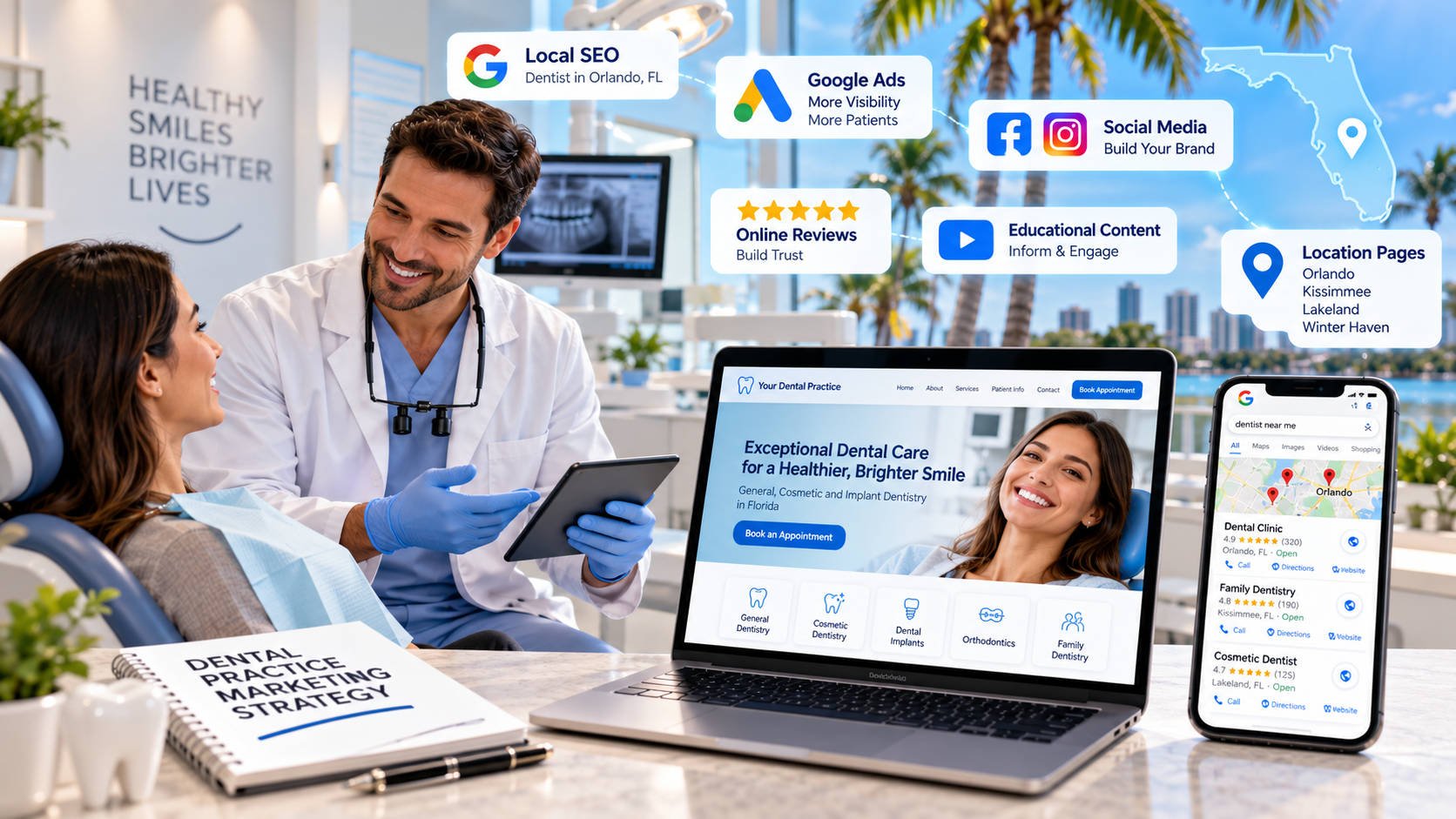
Patients often research a dental practice online before deciding where to schedule an appointment. They may visit the clinic’s website, check Google reviews, explore social media profiles, compare available services, and look for information about the dental team.
For dentists and dental clinics in Florida, having a professional online presence is an important part of building a recognizable and trustworthy practice.
However, simply creating a website or maintaining a social media account is not enough. Your digital presence should communicate what your practice offers, reflect your professional identity, provide useful information, and create a consistent experience across different online platforms.
Effective dental practice marketing brings together website design, search engine optimization (SEO), local search visibility, social media, content marketing, and online reputation management.
In this guide, we explain how Florida dental practices can strengthen their online presence, build brand credibility, and create a consistent digital identity that supports long-term business growth.
1. Why Dental Practice Marketing Matters for Building a Strong Online Presence
A dental practice’s online presence influences how potential patients discover and evaluate its services. Before contacting a clinic, people may want to understand its location, available treatments, office environment, and professional background.
A well-maintained digital presence helps answer these questions and gives visitors a clearer understanding of your practice.
A strong online presence can help dental practices:
- Establish a recognizable professional identity.
- Improve visibility in relevant search results.
- Communicate available dental services clearly.
- Share useful oral health information.
- Build credibility through genuine patient feedback.
- Maintain consistent communication across digital platforms.
- Make important practice information easier to find.
For example, someone searching for a dental clinic in Orlando may compare several websites before deciding which practice to contact. A professional website, accurate business information, useful content, and genuine reviews can help your practice make a stronger first impression.
Your online presence should work as a connected system rather than a collection of unrelated digital profiles.
2. Develop a Professional Dental Practice Website
Your website is the central platform for your dental practice’s online identity. It should clearly communicate your services, introduce your team, provide essential clinic information, and help visitors understand what to expect.
A professional dental website should balance visual presentation with usability and accessibility.
Important website elements include:
- Homepage: Introduce your dental practice, its location, and the services it provides.
- About Us Page: Share information about the practice, dental team, professional experience, and approach to patient care.
- Dedicated Service Pages: Create separate pages for services such as general dentistry, cosmetic dentistry, dental implants, orthodontics, and other treatments actually offered.
- Contact Page: Display accurate contact information, clinic address, operating hours, and appointment enquiry options.
- Patient Information: Provide relevant details about first visits, consultations, and common questions.
- Mobile-Friendly Layout: Make sure visitors can navigate the website comfortably on smartphones and tablets.
- Clear Navigation: Organize pages so visitors can find the information they need without unnecessary steps.
A website should also load efficiently, use readable typography, and provide clear calls to action.
Avoid overcrowding pages with excessive promotional messages. Focus on presenting useful information in a professional and organized way.
3. Create a Consistent Dental Brand Identity
Branding is more than choosing a logo or color palette. It is the overall impression people develop when they interact with your dental practice online and offline.
A consistent identity helps your practice become recognizable across your website, social media profiles, advertisements, and other communication channels.
Key elements of dental practice branding include:
Logo and Visual Identity: Use a recognizable logo and a consistent visual style across your digital platforms.
Brand Colors and Typography: Choose professional colors and readable fonts that work well on websites, social media graphics, and marketing materials.
Photography Style: Use clear, professional photographs of your clinic, team, facilities, and relevant services.
Brand Voice: Maintain a consistent communication style that is professional, approachable, informative, and easy to understand.
Messaging: Clearly communicate your practice’s services, approach, and relevant strengths without making unsupported claims.
For example, a family dental practice may use welcoming visuals and straightforward educational messaging, while a cosmetic dentistry practice may emphasize treatment information, professional presentation, and its available services.
Your branding should accurately represent your practice and create a consistent experience wherever people encounter it.
4. Improve Your Dental Practice’s Search Engine Visibility
A professional website is more valuable when people can discover it through search engines.
Search engine optimization helps your dental practice appear for relevant searches related to your services, location, and the information potential patients are looking for.
For Florida dental practices, location-based searches are particularly important because people often look for dental services within a specific city or nearby community.
Examples of location-based dental searches include:
- Dentist in Orlando, FL
- Dental clinic in Kissimmee, FL
- Cosmetic dentist in Lakeland, FL
- Dental implants in Winter Haven, FL
These examples show how patients may combine a dental service or provider with a specific location when searching online.
Important dental SEO activities include:
- Researching relevant dental service and location-based keywords.
- Creating dedicated pages for individual dental services.
- Writing informative and original website content.
- Optimizing page titles, meta descriptions, and headings.
- Improving website loading speed and mobile usability.
- Adding descriptive image alt text.
- Creating relevant internal links between website pages.
- Monitoring search performance through Google Search Console.
For example, a dental practice offering cosmetic dentistry and dental implants should provide separate, informative pages for those treatments rather than targeting every dental keyword on one general page.
SEO should focus on helping people find accurate information rather than simply repeating keywords throughout the website.
5. Optimize Your Google Business Profile
For a dental practice serving a specific community, Google Business Profile is an important part of its local online presence.
It can help people discover your clinic through Google Search and Google Maps while providing essential business information.
Keep your Google Business Profile updated with:
- Accurate practice name and address.
- Correct contact number and website link.
- Current operating hours.
- Relevant business categories.
- Dental services actually offered.
- Recent clinic and team photographs.
- Genuine patient reviews.
- Appropriate updates and announcements.
Regularly review your profile to ensure that the information matches your website and other business listings.
For multi-location dental businesses, each eligible clinic location should have accurate and appropriately managed business information.
For example, dental practices serving Orlando, Sanford and Lakeland may need separate location pages that provide accurate clinic information, available services, and relevant details about each location.
These pages should reflect the actual locations and services of the practice. Avoid creating location pages for areas where the business does not have a genuine service presence.
6. Use Educational Content to Build Patient Trust
People often search online for information about dental treatments, oral hygiene, and common dental concerns. Educational content gives your practice an opportunity to answer relevant questions and demonstrate its professional knowledge.
Rather than publishing only promotional posts, create useful content that helps visitors understand dental topics.
Educational content ideas for dental practices include:
- How to maintain a daily oral hygiene routine.
- What to expect during a routine dental checkup.
- Common questions about professional teeth cleaning.
- General information about dental implants.
- Differences between available orthodontic treatments.
- Tips for maintaining oral health.
- Questions patients may want to ask before a dental procedure.
- Information about children’s dental visits.
You can publish this information through blog articles, website resources, short videos, and social media posts.
For example, a blog explaining what happens during a routine dental examination can introduce the process, explain common steps, and answer frequently asked questions.
Keep educational content accurate, easy to understand, and appropriately reviewed by a qualified dental professional. Avoid presenting general information as a diagnosis or personalized treatment recommendation.
7. Build a Professional Social Media Presence
Social media gives dental practices another way to communicate with their audience, introduce their team, share educational information, and maintain a recognizable brand identity.
Facebook and Instagram can support dental practice branding through a consistent combination of photographs, videos, educational posts, and practice updates.
Social media content ideas include:
- Dental team introductions.
- Clinic interiors and facilities.
- General oral hygiene tips.
- Educational dental videos.
- Explanations of services offered.
- Frequently asked dental questions.
- Clinic announcements and updates.
- Professional milestones and community participation.
- Patient feedback shared with appropriate permission.
Maintain a consistent visual identity across your posts. Use the same brand colors, typography, and communication style to help audiences recognize your practice.
A practical content calendar can help organize posts and maintain consistency without overwhelming your audience with promotional material.
Remember to protect patient privacy. Do not share identifiable patient photographs, treatment details, or testimonials without appropriate documented permission and compliance with applicable privacy requirements.
8. Manage Online Reviews and Your Dental Practice’s Reputation
Online reviews are an important part of how people evaluate local dental practices. Potential patients may read feedback to understand other people’s experiences and assess the clinic’s professionalism.
A well-managed online reputation helps communicate how your practice interacts with its patients.
Ways to manage your online reputation include:
- Encourage genuine feedback from patients.
- Make it convenient for patients to share their experiences.
- Monitor reviews across relevant platforms.
- Respond professionally and respectfully.
- Address concerns through appropriate private communication.
- Avoid disclosing patient information in public responses.
- Never purchase or fabricate reviews.
When responding to a negative review, avoid discussing treatment details or confirming someone is a patient. A general, professional response that respects privacy is preferable.
For example, your practice can acknowledge the feedback, express willingness to address concerns through an appropriate private channel, and provide a suitable contact method.
Online reputation management should be an ongoing activity rather than something addressed only when negative feedback appears.
9. Use Before-and-After Content Responsibly
Before-and-after photographs can help explain certain dental procedures by showing visual treatment outcomes. However, this type of content needs careful planning and appropriate patient consent.
If your practice shares treatment-related images, make sure the content is accurate, professionally presented, and compliant with applicable advertising and privacy requirements.
Important considerations include:
- Obtain appropriate written patient authorization before using identifiable photographs.
- Clearly explain what the images represent.
- Avoid editing photographs in ways that misrepresent treatment outcomes.
- Do not imply that every patient will achieve the same result.
- Include relevant context where necessary.
- Protect patient records and personal information.
Before-and-after content should educate viewers rather than create unrealistic expectations.
Dental practices should also review applicable professional advertising rules before publishing treatment claims or promotional material.
10. Maintain Consistent Branding Across Digital Platforms
Your dental practice may appear on several platforms, including your website, Google Business Profile, Facebook, Instagram, online directories, and healthcare-related listings.
If these platforms display inconsistent information or different branding, visitors may find it difficult to identify the official practice.
Maintaining consistency helps create a more professional and recognizable digital presence.
Create a simple brand consistency checklist:
Element | What to Maintain |
Business Name | Use the correct practice name |
Logo | Use consistent and current branding |
Contact Information | Keep phone numbers and addresses accurate |
Website Link | Direct visitors to the official website |
Brand Colors | Maintain a consistent visual identity |
Business Description | Use accurate and consistent service information |
Photography | Use professional and relevant clinic images |
Communication Style | Maintain a recognizable brand voice |
Review your important digital profiles periodically and update information whenever your practice changes its services, contact details, branding, or operating hours.
11. Measure Your Dental Practice’s Online Visibility
Building an online presence requires regular monitoring. Tracking performance helps you understand whether your website and digital platforms are reaching the right audience.
Instead of focusing only on follower counts or website visits, monitor the metrics that provide meaningful information about your online visibility and user engagement.
Useful metrics to monitor include:
Metric | What It Helps You Understand |
Organic Website Traffic | Visitors arriving through unpaid search results |
Search Impressions | How often your pages appear in Google search results |
Keyword Rankings | Visibility for relevant dental searches |
Website Engagement | How visitors interact with your website |
Google Business Profile Activity | Customer interactions with your business profile |
Social Media Engagement | Audience interactions with your content |
Review Activity | New feedback and reputation trends |
Website Enquiries | Contact forms, calls, and other enquiries generated through your website |
Appointment Requests | Number of appointment enquiries and bookings generated through online channels |
Tools such as Google Analytics 4 and Google Search Console can help you monitor website activity and search performance. Your appointment booking system or CRM can provide additional information about appointment requests and enquiries.
Use the findings to identify which pages perform well, which topics attract interest, and where your digital presence needs improvement.
Common Online Branding Mistakes Dental Practices Should Avoid
Even dental practices that invest in digital marketing can struggle to maintain a professional online presence when their activities lack consistency.
Here are some common mistakes to avoid:
- Using an Outdated Website
An outdated design, difficult navigation, or missing information can make it harder for visitors to understand your practice.
- Inconsistent Branding
Different logos, colors, descriptions, and contact information across platforms can create confusion.
- Publishing Only Promotional Content
A social media profile filled entirely with advertisements may offer limited educational value. Include useful information and practice updates.
- Ignoring Online Reviews
Failing to monitor reviews or responding unprofessionally can negatively affect how people perceive your practice.
- Neglecting Local SEO
An incomplete business profile and poorly optimized location pages can make it harder for local audiences to discover your clinic.
- Using Low-Quality Images
Unclear photographs of your clinic, team, or facilities can weaken your overall digital presentation.
- Sharing Patient Information Without Proper Permission
Patient photographs, testimonials, and treatment information must be handled carefully and in accordance with applicable privacy and consent requirements.
Avoiding these mistakes can help your practice maintain a consistent and professional digital identity.
How to Build a Practical Online Marketing Plan for Your Dental Practice
You do not need to implement every marketing activity at once. A structured plan makes it easier to improve your digital presence step by step.
Phase | Marketing Activity | Main Objective |
Phase 1 | Website design and content review | Establish a professional website |
Phase 2 | Branding and visual consistency | Create a recognizable identity |
Phase 3 | SEO and Google Business Profile optimization | Improve search visibility |
Phase 4 | Educational content development | Share useful dental information |
Phase 5 | Social media and reputation management | Maintain audience engagement and credibility |
Phase 6 | Analytics and performance review | Measure results and identify improvements |
The timeline for improvements depends on your website’s current condition, competition, service areas, content quality, and consistency of execution.
A connected approach helps your website, search presence, social media, and online reputation support the same overall brand identity.
Why Florida Dental Practices Need a Strong Digital Marketing Strategy
Florida has dental practices serving different communities, patient needs, and local markets. A dental clinic’s digital marketing approach should reflect its services, audience, location, and business objectives.
For example, a dental practice serving Orlando may have different local content requirements from a clinic operating in Kissimmee or Lakeland.
Dental practices targeting different Florida markets can develop location-specific website content to address local search queries and provide relevant information about their services and clinic locations.
Location-focused digital marketing can help dental practices communicate relevant services and information to the communities they serve.
A well-planned strategy can help Florida dental practices:
- Develop a recognizable online brand.
- Improve visibility for relevant dental searches.
- Present services and clinic information professionally.
- Share educational content with their audience.
- Build credibility through genuine patient feedback.
- Maintain consistent communication across digital platforms.
- Monitor online performance and identify improvement opportunities.
The goal is to create an accurate, useful, and professional digital presence that reflects the quality and identity of your dental practice.
Choose the Right Digital Marketing Partner for Your Dental Practice
Managing website design, SEO, content creation, social media, and online reputation requires time and consistent planning.
Working with a digital marketing agency that understands the needs of dental businesses can help coordinate these activities through a structured approach.
When evaluating a marketing partner, consider its ability to:
- Understand your dental services and target audience.
- Develop a professional website and content strategy.
- Improve relevant local and organic search visibility.
- Maintain consistent branding across digital platforms.
- Create educational and engaging social media content.
- Support online reputation management.
- Monitor performance and provide meaningful reports.
Your marketing partner should understand that dental marketing requires more than promotional content. It should communicate accurate information, maintain patient privacy, and represent your practice professionally.
Strengthen Your Dental Practice’s Online Presence With Boltz Media
Building a strong online presence takes more than maintaining a website or publishing occasional social media posts. Your website, branding, search visibility, content, and online reputation should work together to create a consistent digital identity.
At Boltz Media, we provide digital marketing solutions designed to help dental practices strengthen their online presence. From website design and SEO to social media marketing, online advertising, and content development, our services support a coordinated approach to digital growth.
Whether you operate an independent dental clinic or a multi-location dental practice in Florida, a well-planned marketing strategy can help communicate your services, establish credibility, and improve your digital visibility.
Explore our Digital Marketing Services for Dentists in Florida to learn how we can support your dental practice with a focused online marketing strategy.
Frequently Asked Questions (FAQs)
1. Why is online marketing important for dental practices?
Online marketing helps dental practices communicate their services, improve search visibility, share educational information, and establish a recognizable brand. It also gives potential patients convenient access to important clinic information.
2. What should a professional dental website include?
A professional dental website should include an introduction to the practice, dedicated service pages, information about the dental team, contact details, operating hours, useful patient information, and clear appointment enquiry options.
3. How can dentists improve their online visibility?
Dentists can improve online visibility through SEO, local search optimization, an accurate Google Business Profile, useful website content, consistent social media activity, and professional online reputation management.
4. Why is Google Business Profile important for dentists?
Google Business Profile helps people discover dental practices through Google Search and Maps. It provides important information such as the clinic’s location, contact details, operating hours, website, services, and customer reviews.
5. How does social media help dental practices?
Social media allows dental practices to introduce their team, share educational content, communicate practice updates, showcase their facilities, and maintain a consistent brand identity across platforms.
6. How can dental practices build a positive online reputation?
Dental practices can build a positive online reputation by encouraging genuine patient feedback, monitoring reviews, responding professionally, addressing concerns appropriately, and protecting patient privacy.
7. How often should dental practices update their websites?
Dental practices should review their websites regularly and update them whenever services, contact details, team information, operating hours, or other important business information changes. Educational content and website performance should also be reviewed periodically.
8. What digital marketing services do dental practices need?
Depending on their objectives, dental practices may benefit from website design, SEO, local SEO, social media marketing, content development, online advertising, and reputation management. The right combination depends on the practice’s audience, location, and marketing goals.