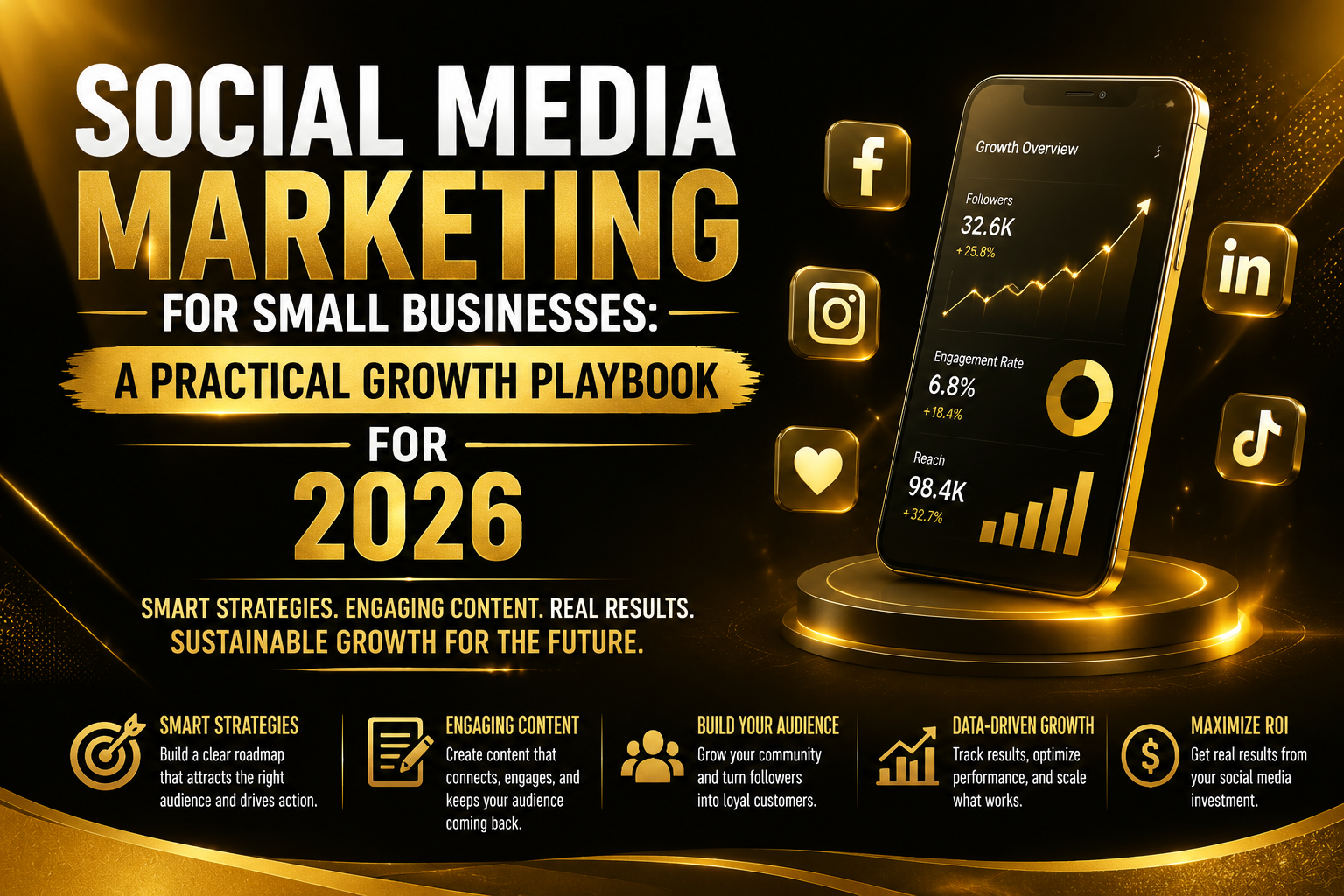
Social media marketing for small businesses has gotten harder, not easier, over the last three years. Organic reach has shrunk, algorithms favor video over everything else, and the bar for content quality keeps rising. At the same time, customers research businesses on Instagram, Facebook, and TikTok before they ever pick up the phone, which means a weak social presence is now actively hurting your bottom line. Doing nothing is no longer a neutral choice. It is a slow loss of trust to competitors who show up consistently.
This playbook is built for small business owners and marketing managers who want a practical, no-fluff approach to social in 2026. We will skip the surface-level tips and walk through what actually works for service businesses, retail, restaurants, and B2B operators trying to grow without a corporate marketing department. Every section is rooted in what is producing results right now, not legacy advice from older content cycles.
Why Social Media Still Matters for Small Businesses
Some skeptical owners ask whether social media is even worth the time anymore, and the honest answer is yes, but for a different reason than most people think. Social media in 2026 is not primarily a direct sales channel for small businesses. It is a trust and awareness layer that sits between discovery and conversion. Customers find you on Google, but they vet you on Instagram and Facebook. If your social presence looks abandoned, generic, or unprofessional, the lead never makes it to your contact form.
This is why social media works best when it is integrated with the rest of your marketing, not run in isolation. The same trust signals that drive conversions on social also feed your local SEO performance, because review sites, AI search engines, and Google itself increasingly factor social signals into how they assess businesses.
Choosing the Right Platforms for Your Business
Most small businesses spread themselves too thin across too many platforms. The smarter play is to pick the two or three that actually match where your customers spend their time and to dominate those, rather than posting halfheartedly across six channels. Here is a practical 2026 platform breakdown.
Instagram and Facebook
Still the foundational platforms for most small businesses, especially in service industries, retail, healthcare, and home services. Meta’s combined audience covers nearly every adult demographic in the United States. Instagram skews toward visual storytelling and younger audiences, while Facebook still dominates for forty-plus customers and local community engagement. Most small businesses should be active on both, treating them as one connected ecosystem rather than two separate efforts.
TikTok and Instagram Reels
Short-form video is the single highest-leverage content format in 2026. Reels and TikToks routinely deliver ten to one hundred times the organic reach of static posts. Even businesses that resist video should be experimenting here, because the algorithm rewards consistency and the cost of falling behind is significant. A simple thirty-second video filmed on a phone consistently outperforms a polished static graphic in reach and engagement.
Critical for B2B businesses, professional services, and consultants. LinkedIn rewards thoughtful written posts, document carousels, and personal storytelling from founders. If your customers are other businesses, LinkedIn deserves more of your attention than Instagram.
YouTube
Underrated for small businesses. YouTube is both a social platform and the second-largest search engine in the world, which means content lives for years instead of disappearing in a feed. Service businesses that publish how-to content on YouTube often build the most durable lead pipelines.
Pinterest, X, Threads, and Niche Platforms
Useful for specific industries. Home services, weddings, food, and decor businesses can win on Pinterest. Some B2B and tech-adjacent brands still find traction on X. Most other small businesses should ignore these unless they have already mastered the core platforms.
Building Content Pillars That Work
The fastest way to lose at social media is to post randomly without a strategic framework. Content pillars solve this problem. A pillar is a recurring content theme that supports your business goals, makes posting easier, and gives your audience a reason to follow you. Most small businesses should run with four pillars.
Pillar One: Educational Content
Answer the questions your customers actually ask. If you run a roofing company, that means content about how to spot storm damage, when to repair versus replace, and how insurance claims work. Educational content positions you as an expert and earns trust before you ever pitch anything.
Pillar Two: Behind the Scenes
People buy from people they trust. Behind-the-scenes content showing your team, your process, your office, and your daily work humanizes your brand in ways no polished marketing asset can match. Florida customers especially respond to authentic, locally-rooted content that feels like a real business, not a corporate machine.
Pillar Three: Social Proof and Customer Stories
Testimonials, case studies, before-and-afters, and customer features. This is the most under-used content type in small business social media. A two-minute video of a happy customer telling their story will outperform almost any other content you can produce, and it doubles as social proof you can repurpose on your website and ads.
Pillar Four: Promotions and Calls to Action
The smallest pillar, but still essential. Promotions, special offers, service availability, and direct CTAs to book consultations or visit your website. The trick is keeping this pillar to no more than twenty percent of your content, since accounts that feel pushy lose followers fast.
Posting Cadence That Actually Works
Cadence matters more than perfection. Posting three high-quality times per week consistently for twelve months will beat posting daily for six weeks and then quitting. Here are practical 2026 cadences that work for most small businesses.
- Instagram and Facebook: three to five posts per week, with a mix of static posts, Reels, and Stories. Stories should run daily, even if posts run less often.
- TikTok: three to seven Reels or TikToks per week. Volume matters more here than on any other platform.
- LinkedIn: two to three posts per week, with at least one substantive long-form post.
- YouTube: one to two videos per month, prioritizing quality and SEO-driven topics over frequency.
If this volume feels overwhelming, that is normal. Most small business owners cannot sustain it while also running their business, which is why outsourcing to a partner often pays for itself within the first quarter.
How Short-Form Video Won 2026
If you take only one thing from this playbook, take this: short-form video is the most important content format you can produce. The algorithms on Instagram, Facebook, TikTok, YouTube Shorts, and even LinkedIn now prioritize video, and the gap between video reach and static reach has widened every quarter for the last two years.
Good news: short-form video does not require a film crew. The most effective videos for small businesses are often shot on a phone in under five minutes. What matters is the hook in the first two seconds, the clarity of the message in the next ten, and a clear reason for the viewer to engage at the end. Polish helps, but consistency matters more.
Common formats that consistently work include explainer videos, behind-the-scenes clips, customer testimonial cuts, before-and-after reveals, day-in-the-life content, and quick tips related to your industry. Pick two or three formats that fit your brand and produce them on a repeatable weekly rhythm.
Measuring What Actually Matters
Vanity metrics like follower count and likes are mostly noise. Here is what a serious social media program should track in 2026.
- Profile visits, which signal genuine interest in your brand.
- Saves and shares, which the algorithm weighs heavily and which indicate content depth.
- Click-throughs to your website, which connect social to actual revenue.
- Direct messages and inquiries, which often outpace contact form submissions for small businesses.
- Branded search volume, which tells you whether social is driving people to look you up directly on Google.
- Customer acquisition cost from social, calculated by tracking which leads originally discovered you on social.
Set up a simple monthly dashboard tracking these six numbers and you will know within ninety days whether your social strategy is actually working.
Common Mistakes That Kill Small Business Social Media
- Posting only promotional content. Audiences disengage immediately when every post is a sales pitch.
- Inconsistent visual identity. Mismatched fonts, filters, and colors make accounts look unprofessional.
- Ignoring DMs and comments. Engagement is two-way. Failing to respond signals an absent business.
- Buying followers. The algorithm punishes accounts with mismatched follower-to-engagement ratios.
- Spreading too thin. Mediocre presence on six platforms is worse than dominant presence on two.
- Treating social as a side task. The accounts that win are the ones with dedicated time and budget.
How Social Media Integrates With Your Broader Marketing
Social does not stand alone. It is one channel inside a larger ecosystem that includes your website, your SEO, your email marketing, your paid ads, and your brand foundation. The small businesses that win in 2026 are the ones that connect every channel into a cohesive customer journey. If your website design is weak, traffic from social will not convert. If your local SEO foundations are missing, you are leaving the highest-intent traffic untouched. If you have not yet decided who should run all of this, our agency buyer’s guide walks through how to choose the right partner.
How Boltz Media Helps Small Businesses Win on Social
At Boltz Media, social media marketing is one of the core services we deliver to clients across Central Florida and beyond. We handle strategy, content creation, video production, scheduling, community management, and reporting, so the business owner can focus on running the business. Our team is built around the belief that authentic, locally-rooted content beats polished generic content every time, which is why our clients consistently see real growth in followers, engagement, and inbound leads. Browse our portfolio to see examples of recent work.
Final Thoughts: Start Small, Stay Consistent, Compound Over Time
The small businesses that dominate social media in 2026 are not the ones with the biggest budgets. They are the ones that started consistently posting authentic content eighteen months ago, refined their approach quarter over quarter, and stayed in the game when others quit. Social media rewards patience and punishes inconsistency, which means the time to start is always now.
If you are ready to take social media seriously and want a partner that will treat your brand like it is their own, schedule a free consultation with our team. We will walk through your goals, audit your current presence, and show you exactly what a serious social strategy could look like for your business.