For many Florida businesses, getting customers through organic search takes time. Google Ads can provide another way to reach people who are actively searching for products and services.
But running Google Ads is not simply a matter of choosing a few keywords, setting a budget, and waiting for leads.
Your results depend on factors such as competition, location, search intent, landing-page quality, campaign structure, ad relevance, conversion tracking, and the value of each customer.
For a small business in Florida, one of the most important questions is:
How much should you actually spend on Google Ads, and what should you expect in return?
There is no universal budget that works for every company. A local service business in Ocala may have very different advertising requirements from a company competing for customers across Orlando, Miami, Tampa, Jacksonville, or the entire state.
This guide explains how Google Ads Florida campaigns work, what influences advertising costs, how to set a realistic budget, and what Florida businesses should measure before deciding whether to increase their investment.
What Are Google Ads for Florida Businesses?
Google Ads is a paid advertising platform that allows businesses to show advertisements across Google’s advertising network based on factors such as search queries, audience signals, campaign settings, and other targeting criteria.
For a Florida business, campaigns can be designed around specific services, products, locations, or customer groups.
For example, a local business might target searches related to:
- Emergency plumbing services in Orlando
- HVAC repair in Lakeland
- Web design in Florida
- Dental services in Melbourne
- Roofing companies in Daytona Beach
- Legal services in Tampa
- Manufacturing suppliers in Jacksonville
The important point is that Google Ads Florida campaigns should be connected to a specific business objective.
That objective might be:
- Generate phone calls
- Get quote requests
- Generate appointment bookings
- Sell products
- Generate B2B inquiries
- Promote a specific service
- Increase qualified website traffic
The campaign should be designed around the desired outcome rather than simply maximizing clicks.
How Much Should a Florida Business Spend on Google Ads?
There is no fixed Google Ads budget that every Florida business should use.
A practical starting budget depends on:
- Industry
- Competition
- Target locations
- Average customer value
- Search volume
- Number of services
- Geographic coverage
- Conversion rate
- Cost per click
- Sales capacity
A business targeting one local service area may be able to start with a smaller budget than a company targeting multiple cities or statewide customers.
For example, a local contractor might begin with a tightly focused campaign around one high-value service and one geographic market.
A larger company could require multiple campaigns covering several services and Florida markets.
Instead of asking:
“What is the cheapest Google Ads budget?”
ask:
“What budget gives us enough qualified traffic and conversion data to evaluate the campaign?”
That is a more useful starting point.
Businesses comparing paid advertising with longer-term organic strategies can also review our guide on how much SEO costs in Florida to understand how different search investments can fit into a broader marketing budget.
Google Ads Budget vs. Google Ads Management Cost
One important distinction is the difference between advertising spend and campaign management fees.
Your advertising budget is the money paid toward running your ads.
Management costs are what you may pay an agency or specialist to research keywords, create campaigns, write ads, optimize landing pages, analyze performance, and manage the account.
These are separate expenses.
For example, a business could have:
Google Ads budget: Money allocated to advertising
Management fee: Cost of professional campaign management
Landing page investment: Cost of creating or improving pages used by the campaigns
Understanding this difference helps businesses compare proposals more accurately.
A proposal should clearly explain what is included and whether advertising spend is separate from management.
What Determines Google Ads Cost in Florida?
Google Ads costs vary significantly because different searches have different levels of competition and commercial value.
1. Industry Competition
Some industries have many advertisers competing for the same searches.
Competitive categories may require more investment to generate meaningful visibility.
A business should therefore avoid assuming that the cost of advertising for one industry represents the cost for another.
2. Location
The geographic area you target affects the campaign.
A campaign targeting one Florida city is different from a statewide campaign.
For example:
Orlando only
is a narrower targeting strategy than:
Orlando + Kissimmee + Lakeland + Tampa + Miami + Jacksonville
The larger the geographic footprint, the more potential search traffic and budget may be required.
3. Keyword Intent
Not every keyword has the same business value.
Compare:
“What is SEO?”
with:
“SEO agency Florida”
The second search indicates stronger commercial intent because the person may already be looking for a provider.
High-intent searches can be particularly valuable for lead-generation campaigns, although competition and costs can also be higher.
4. Customer Value
Your advertising budget should be connected to the value of a customer.
If a business earns a small amount from each transaction, its acceptable acquisition cost may be different from a company that earns thousands of dollars from one customer.
This is why Google Ads Florida budgeting should start with business economics rather than an arbitrary monthly number.
What Is PPC Florida?
PPC Florida refers to pay-per-click advertising campaigns targeted toward Florida audiences.
Google Ads is one of the most widely used PPC platforms, but PPC can include other paid advertising channels as well.
A PPC strategy generally involves:
- Keyword research
- Audience targeting
- Ad creation
- Campaign structure
- Bid and budget management
- Landing-page optimization
- Conversion tracking
- Performance analysis
The basic concept is straightforward:
Target the right audience → show a relevant ad → send them to a useful page → encourage a conversion → measure the result.
The difficult part is optimizing each step.
How Should You Structure a Google Ads Campaign?
A well-organized campaign should make it easy to understand what is working.
For example, a Florida web design company could structure campaigns around:
Campaign 1: Website Design
→ website design Florida
→ web design Florida
→ business website design
Campaign 2: SEO
→ SEO services Florida
→ SEO company Florida
→ local SEO services
Campaign 3: Location
→ Orlando web design
→ Tampa web design
→ Miami web design
The exact structure depends on the business and available search volume.
Avoid combining unrelated services into one campaign simply because they are all part of the same company.
More focused campaigns can make ad messaging and landing pages more relevant.
Why Landing Pages Matter
One of the biggest mistakes businesses make is sending every Google Ads visitor to the homepage.
Imagine someone searches:
“Website design Florida.”
The advertisement promises professional website design.
But the visitor lands on a homepage that talks equally about SEO, social media, photography, advertising, branding, and other services.
The visitor now has to find the information they originally searched for.
A dedicated landing page could instead have:
H1: Website Design Florida
Supporting copy:
Responsive, SEO-friendly websites designed for Florida businesses.
Services:
Website strategy, responsive design, development, SEO structure, and conversion optimization.
Trust signals:
Projects, testimonials, experience, or certifications.
CTA:
Request a Website Consultation.
This creates a much closer connection between the search, advertisement, landing page, and conversion.
Businesses can also explore website design services in Florida when developing landing pages designed to support broader digital campaigns.
What Should You Expect From Google Ads?
Google Ads can create opportunities to reach people who are already searching for relevant products or services, but the actual outcome depends on the campaign, market, and business.
Depending on the campaign objective, you may see:
- Increased search visibility
- Website visits
- Phone calls
- Form submissions
- Quote requests
- Appointment requests
- Product purchases
- B2B inquiries
The type of result you should expect depends on what you are advertising and who you are targeting.
For example, a local emergency service may be focused primarily on phone calls, while an e-commerce business may care more about completed purchases. A B2B manufacturer may receive fewer inquiries but place greater value on each qualified opportunity.
This means businesses should define the desired conversion before judging campaign performance.
A campaign that generates traffic but no relevant business inquiries may need changes to its targeting, messaging, landing page, or conversion path.
The goal is not simply to generate activity. It is to connect advertising activity with a meaningful business action.
Which Google Ads Metrics Should Florida Businesses Track?
Once the campaign is active, businesses need specific metrics to understand how efficiently it is operating.
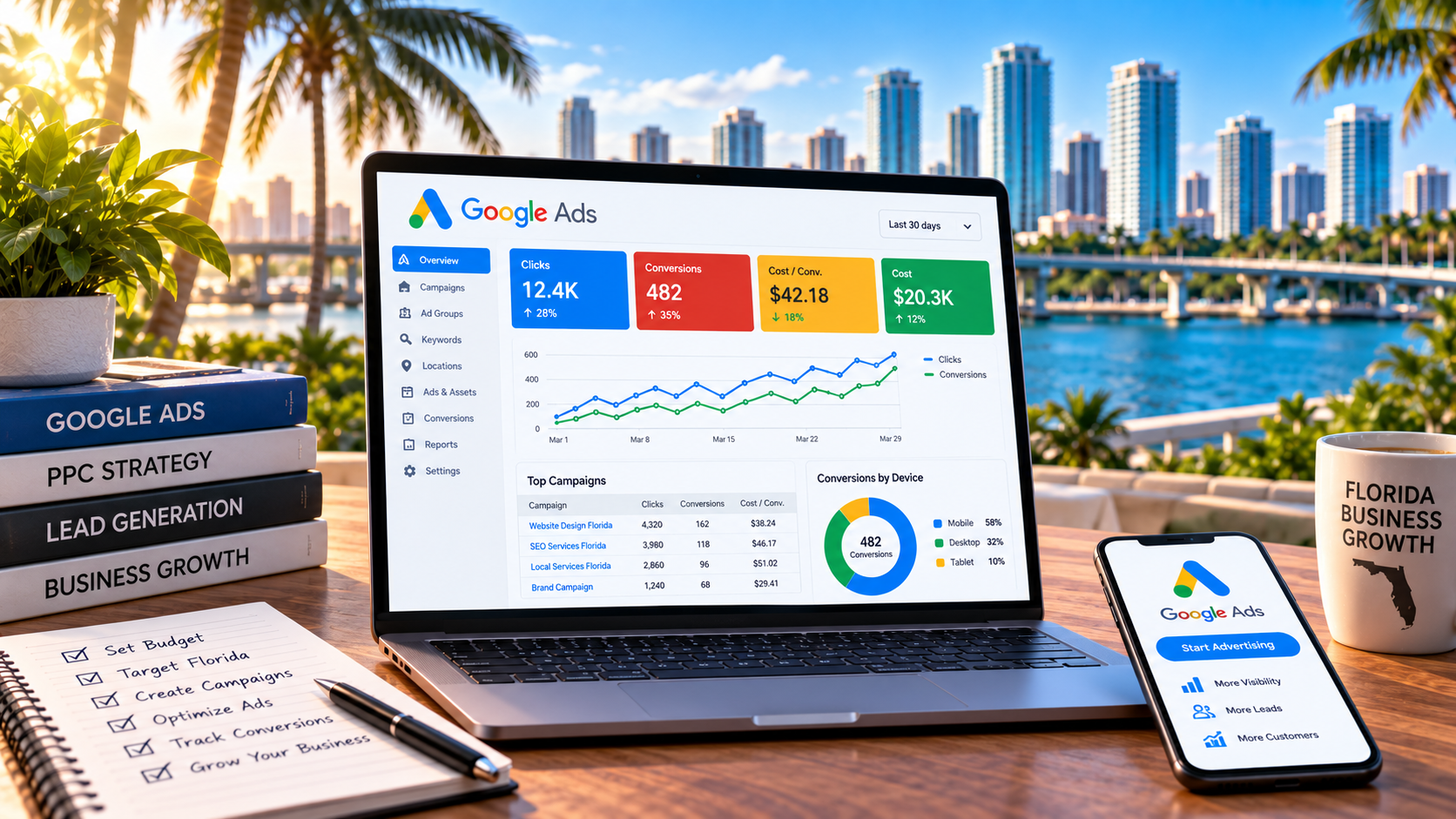
Impressions
Impressions show how often your advertisements were displayed.
This helps evaluate visibility but does not indicate whether users became customers.
Clicks
Clicks show how many users interacted with your advertisements.
This provides information about traffic generation, but clicks alone do not establish business value.
Click-Through Rate
CTR indicates how frequently users click after seeing an advertisement.
It can provide insight into the relationship between ad messaging and the searches in which the ad appears.
Cost Per Click
CPC shows the advertising cost associated with each click.
It can vary depending on competition, keyword intent, targeting, and other campaign factors.
Conversion Rate
Conversion rate measures how frequently relevant visitors complete a defined conversion action.
Depending on the business, this might be a form submission, phone call, appointment request, purchase, or another action.
Cost Per Lead
Cost per lead helps determine how much advertising spend is associated with generating an inquiry.
However, businesses should distinguish between any lead and a qualified lead.
Qualified Lead Rate
This measures the proportion of inquiries that actually match the business’s target customer.
For example, 30 inquiries may appear strong on paper, but if most are outside the service area or unrelated to the service, the campaign may need refinement.
Sales or Revenue
Where tracking allows it, businesses should connect advertising activity to actual sales or revenue.
This creates a clearer picture of whether advertising is contributing to the company’s commercial objectives.
What Should a Good Google Ads Campaign Actually Deliver?
The purpose of campaign analysis is not simply to produce a monthly report.
A well-managed campaign should help the business make better decisions.
Over time, the data should provide answers to questions such as:
- Which services generate the strongest demand?
- Which keywords attract relevant prospects?
- Which Florida locations perform well?
- Which advertisements generate useful engagement?
- Which landing pages support conversions?
- Which search terms should be excluded?
- Where is budget being wasted?
- Where could additional budget be justified?
This is where campaign optimization becomes important.
The first stage may involve testing different keywords, ads, locations, and landing pages.
As more data becomes available, the campaign can be refined by identifying stronger combinations of:
Keyword + Location + Ad + Landing Page + Audience
A good campaign therefore should not just produce numbers. It should produce actionable insights that guide the next round of optimization.
For example, if one service consistently generates qualified inquiries while another generates mostly irrelevant traffic, the business may decide to shift attention toward the stronger opportunity.
The specific decision will depend on the campaign data and business economics.
Should You Target All of Florida?
Not necessarily.
A statewide campaign can make sense for businesses that genuinely serve customers across Florida.
However, a local business may not need statewide advertising.
For example, a local contractor serving Orlando may waste budget by targeting searches from customers hundreds of miles away.
A more focused campaign might target:
- Orlando
- Nearby service areas
- Specific services
- High-intent searches
On the other hand, an e-commerce company shipping throughout Florida may have a legitimate reason to target a much larger geographic area.
The campaign should reflect your actual service area.
Google Ads Florida for Different Types of Businesses
Local Service Businesses
Contractors, electricians, plumbers, HVAC companies, landscapers, cleaning companies, and similar businesses can focus on high-intent service searches in specific Florida markets.
The campaign should make it easy for potential customers to call or request a quote.
Professional Services
Law firms, accountants, consultants, agencies, and other professional service providers may need campaigns built around specific services and customer problems.
Strong landing pages and trust signals can be particularly important.
E-Commerce Businesses
E-commerce campaigns may focus more heavily on products, categories, purchase intent, and revenue.
Tracking should extend beyond clicks to actual sales and profitability.
B2B Companies
B2B campaigns often have lower search volume but potentially higher customer value.
The campaign should focus on qualified inquiries rather than simply maximizing traffic.
For Florida manufacturers and industrial companies, landing pages may need detailed product information, specifications, certifications, and inquiry options.
When Should a Business Hire a Google Ads Agency in Florida?
Some businesses can manage smaller campaigns internally.
However, professional management can be useful when:
- Campaigns are becoming complicated
- Multiple locations are involved
- Several services are being promoted
- Advertising spend is increasing
- Conversion tracking is unclear
- Campaign performance is inconsistent
- Internal staff lacks PPC experience
- Landing pages need improvement
- The business needs regular optimization
A Google Ads agency in Florida may help with keyword research, campaign setup, ad copy, negative keywords, conversion tracking, landing-page strategy, budget allocation, and ongoing optimization.
The important thing is to evaluate what the agency actually provides rather than choosing solely based on its management fee.
For a broader framework on evaluating agencies, see How to Choose the Best Digital Marketing Agency in Florida.
What Should You Ask a Google Ads Agency?
Before hiring a PPC provider, ask:
- How will you determine the initial campaign structure?
- Which keywords would you target?
- How will you handle negative keywords?
- How will you target Florida locations?
- What conversion actions will you track?
- Will advertising spend be separate from management fees?
- How often will campaigns be optimized?
- Who owns the Google Ads account?
- How will you identify qualified leads?
- What reporting will we receive?
The answers should make the campaign process understandable.
A good reporting process should explain not only what happened, but also what will change next and why.
Google Ads vs. SEO for Florida Businesses
Google Ads and SEO serve different purposes.
Google Ads can provide paid visibility when campaigns are active.
SEO focuses on improving organic visibility over time.
A business may use both.
For example:
Google Ads → Immediate paid search visibility
SEO → Long-term organic search visibility
This combination can provide useful coverage across different stages of customer acquisition.
Businesses can explore SEO services in Florida alongside paid advertising when building a broader search strategy.
For a detailed comparison of these two approaches, read Local SEO vs. Google Ads: Which Is Better for Florida Small Businesses?.
The right mix depends on competition, budget, business goals, customer acquisition economics, and the time horizon.
How Google Ads Can Work With Local SEO
For Florida businesses serving specific locations, PPC and local SEO can complement one another.
For example:
Google Ads:
Target high-intent searches for a service in Orlando.
Local SEO:
Build organic visibility for relevant Orlando searches and Google Maps.
Website:
Provide a dedicated service page and clear conversion path.
Reviews:
Support trust during the customer’s research process.
This creates multiple opportunities for a customer to discover the business.
However, each channel should have a clear purpose rather than simply duplicating the same work.
Businesses should also consider how their content performs across modern search experiences. Our guide to Answer Engine Optimization (AEO) for Florida businesses explains how businesses can structure useful content for AI-driven search and answer engines.
Common Google Ads Mistakes Florida Businesses Should Avoid
Sending All Traffic to the Homepage
A relevant landing page can provide a more focused experience.
Targeting Too Many Keywords
A small budget spread across dozens of unrelated searches can make optimization difficult.
Ignoring Negative Keywords
Some searches may generate clicks but have little business value.
Measuring Only Clicks
Clicks do not tell you whether the campaign generates qualified customers.
Not Tracking Conversions
Without conversion tracking, it becomes difficult to evaluate which campaigns actually produce results.
Targeting Locations Too Broadly
A local business should not pay for traffic from areas it cannot serve.
Changing Campaigns Too Frequently
Constant changes can make it difficult to determine which adjustments actually affected performance.
Using Generic Ad Messaging
Ads should clearly match the search intent and landing page.
How Long Does It Take to See Google Ads Results?
Paid advertising can generate visibility and traffic soon after campaigns become active, but meaningful optimization requires data.
Early campaign activity can help identify:
- Which searches generate traffic
- Which ads receive engagement
- Which keywords produce conversions
- Which locations perform better
- Which landing pages need improvement
The timeframe for meaningful business results varies significantly.
A high-demand service in a competitive market behaves differently from a specialized B2B product with limited search volume.
Businesses should therefore avoid promises such as guaranteed leads within a specific number of days.
How to Decide Whether to Increase Your Google Ads Budget
Increasing the budget should be based on performance rather than simply wanting more traffic.
Consider increasing spend when:
- The campaign consistently generates qualified leads
- Conversion tracking is reliable
- Landing pages perform well
- Sales capacity can handle additional demand
- The cost per qualified lead is acceptable
- Additional search demand is available
Before increasing budget, check whether the existing campaign has avoidable waste.
Sometimes improving keyword targeting, landing pages, ad relevance, or conversion tracking can produce better results without immediately increasing spend.
How Much Should You Expect to Pay Per Lead?
There is no single Florida-wide cost-per-lead benchmark that applies to every industry.
The acceptable cost depends on:
Customer value + conversion rate + sales close rate + profit margin
For example, a business selling a high-value service may be able to accept a higher cost per qualified lead than a company selling a low-cost product.
Consider the complete funnel:
Ad click → Website visitor → Lead → Qualified lead → Customer → Revenue
The business should evaluate the cost at the stage that matters most.
Build a Better Google Ads Strategy With Boltz Media
Google Ads can be an important part of a Florida business’s customer acquisition strategy when campaigns are built around clear objectives, relevant search intent, appropriate geographic targeting, strong landing pages, and reliable conversion tracking.
Boltz Media provides digital marketing services that can support businesses across Florida, including online advertising services, SEO, website design, and other digital marketing services.
For a business targeting Florida statewide or specific markets such as Orlando, Kissimmee, Lakeland, Clermont, Ocala, Daytona Beach, Melbourne, or other Florida locations, the campaign should reflect its actual service area and customer base.
The goal should not simply be:
Spend more on Google Ads.
The goal should be:
Spend strategically, measure accurately, improve continuously, and generate qualified business opportunities.
Frequently Asked Questions About Google Ads Florida
How much should a small Florida business spend on Google Ads?
There is no universal budget. The appropriate starting amount depends on industry competition, target locations, search volume, customer value, and campaign objectives. Start with a budget that can generate enough relevant data to evaluate performance.
What is PPC Florida?
PPC Florida refers to pay-per-click advertising targeted toward Florida customers. Google Ads is one of the major PPC platforms used by businesses to reach people searching for relevant products and services.
How much does a Google Ads agency in Florida charge?
Agency pricing varies depending on campaign complexity, advertising spend, number of campaigns, locations, services provided, and management requirements. Ask for a clear breakdown of management fees and advertising spend separately.
Is Google Ads worth it for a Florida small business?
Google Ads can be useful when there is sufficient search demand, the business targets relevant customers, and conversions are tracked properly. Whether it is financially worthwhile depends on the campaign’s cost and the business’s customer economics.
Should I target the entire state of Florida?
Only if your business genuinely serves customers across Florida. A local business may achieve better geographic relevance by focusing its budget on the cities and service areas it can actually serve.
Should Google Ads and SEO be used together?
They can complement each other. Google Ads provides paid visibility while SEO focuses on organic search visibility. The appropriate combination depends on the business’s goals, competition, budget, and customer acquisition strategy.
What should I track in Google Ads?
Track metrics that connect advertising activity to business outcomes, including clicks, cost per click, conversions, cost per lead, qualified leads, conversion rate, and ultimately sales or revenue where tracking is available.
How do I choose a Google Ads agency in Florida?
Look for an agency that can explain its campaign structure, targeting, conversion tracking, reporting, optimization process, fees, and account ownership clearly. Ask how it defines and measures a qualified lead.
Final Takeaway
Google Ads Florida campaigns can help businesses reach customers who are actively searching for products and services, but success depends on more than the advertising budget.
A strong campaign connects:
Search Intent → Targeting → Ad → Landing Page → Conversion → Qualified Lead → Customer
Your budget should reflect your market, customer value, competition, geographic coverage, and business objectives.
For Florida businesses, the most useful question is not simply “How much should I spend?”
It is:
“What level of investment can we manage, measure, and optimize profitably?”
When campaigns are structured around that question, Google Ads becomes a measurable part of a broader digital marketing strategy rather than simply another monthly expense.