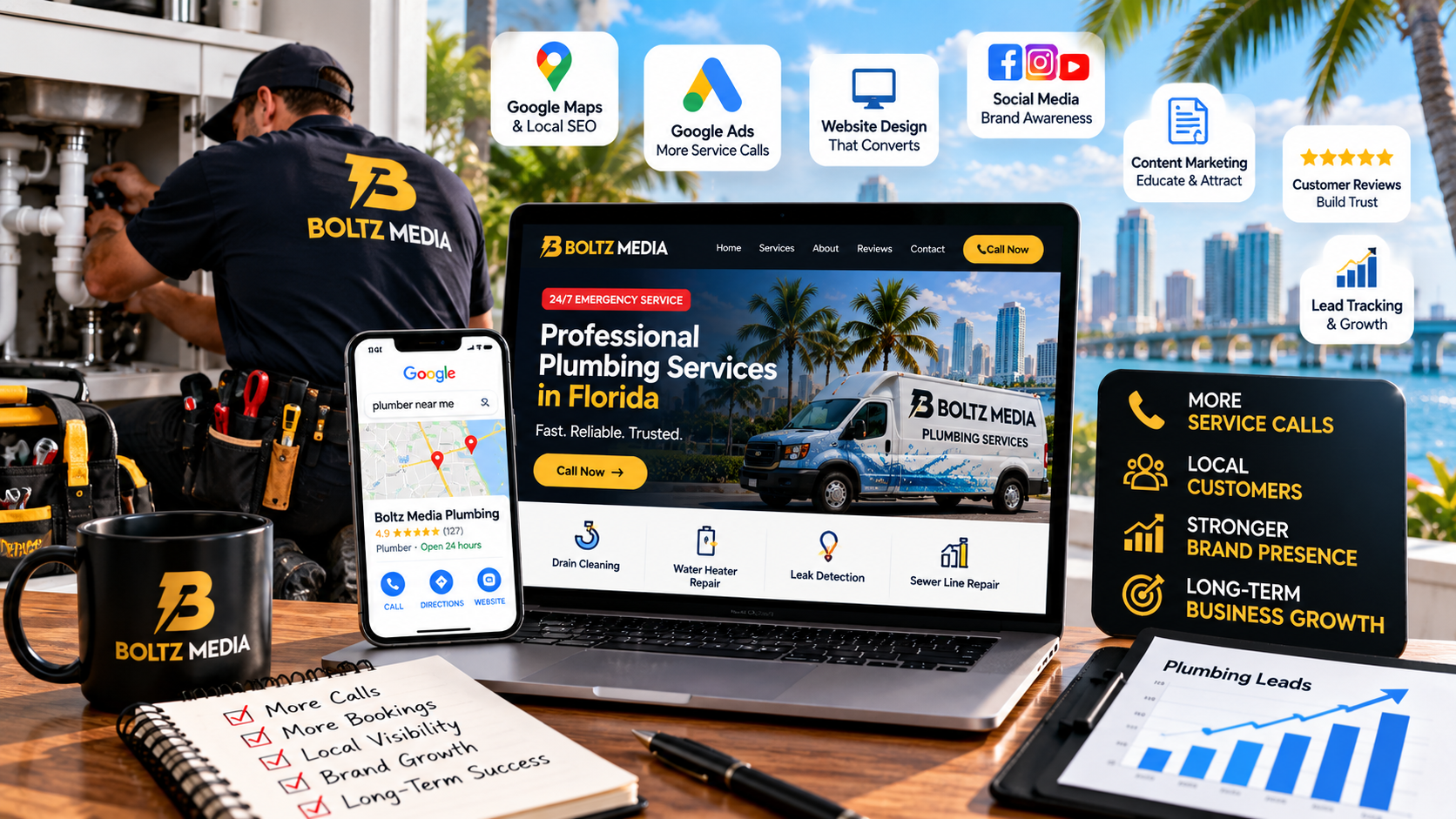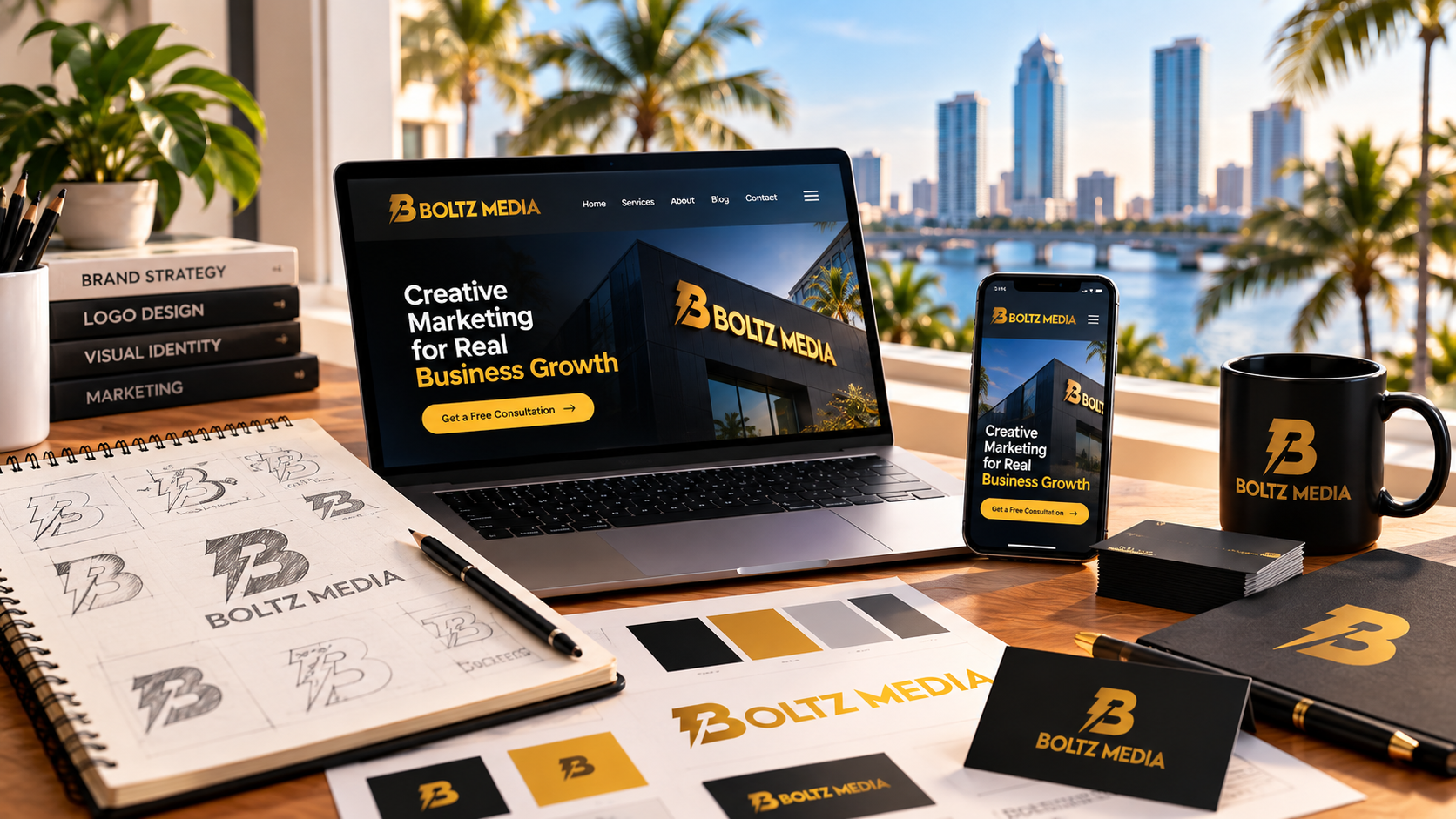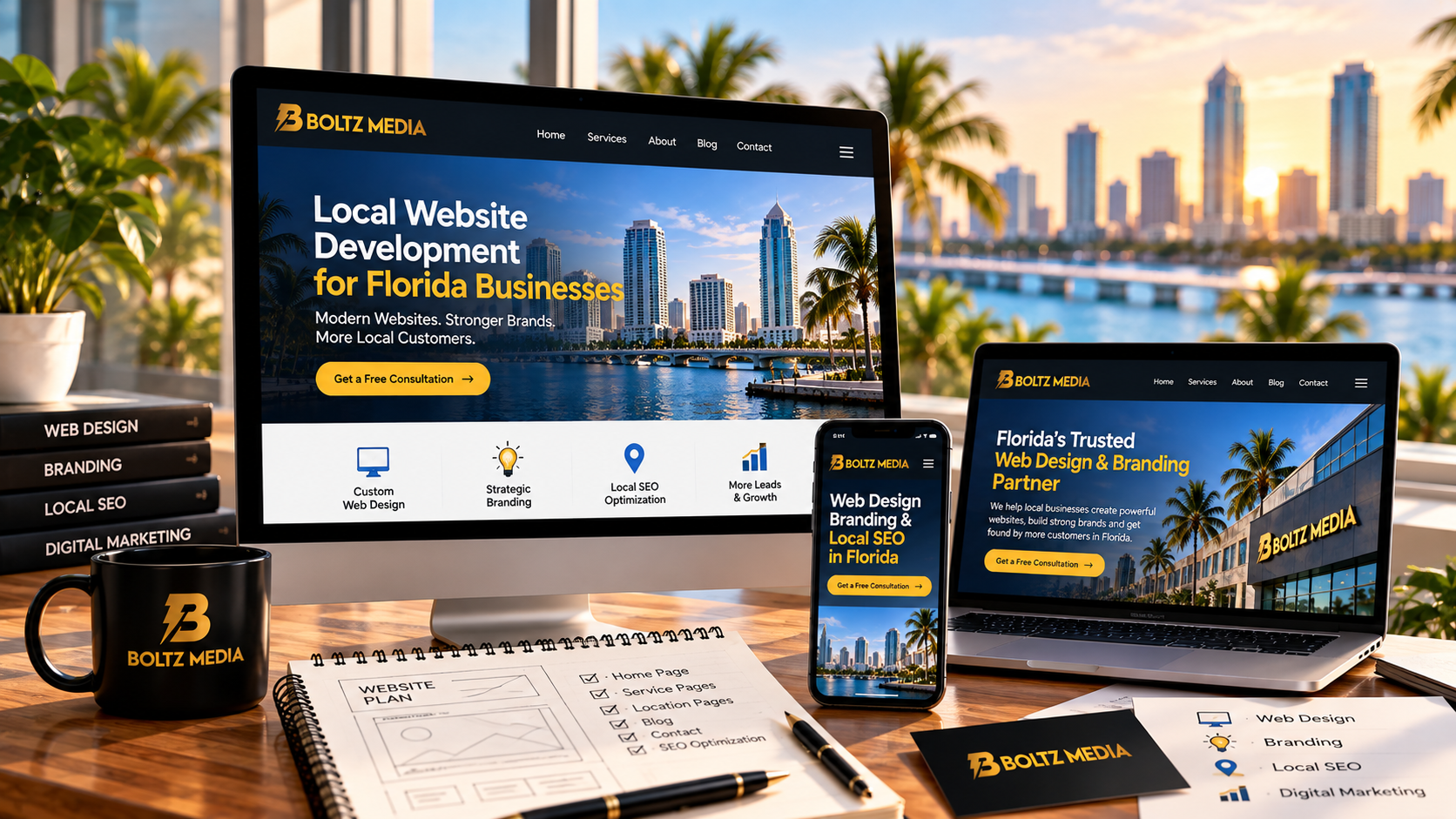
A local business website is more than an online brochure. It can serve as the central place where customers learn about a company, understand its services, explore its service areas, and decide what to do next.
But what exactly does local business website development in Florida mean?
It refers to developing a website around a business’s brand, services, customers, geographic market, and online presence. This includes decisions about website structure, content, navigation, mobile usability, branding, service information, local relevance, and technical elements.
For Florida businesses, understanding these components can help explain why some websites are easier to use, easier to find, and more effective at communicating what a company actually offers.
What Is Local Business Website Development?
Local business website development is the process of creating a website specifically around a business and the market it serves.
A typical website may provide basic information about a company. A local website goes further by clearly connecting the business with its:
- Services
- Customers
- Geographic market
- Brand identity
- Service areas
- Local information
- Customer questions
- Contact options
The goal is not simply to place a business name and location on every page.
Instead, the website should provide useful information that helps visitors understand the relationship between the company, its services, and the communities it genuinely serves.
For example, a Florida service business may explain its service areas, showcase relevant projects, answer common customer questions, and provide information specific to the market.
Local Website Development vs. a Basic Business Website
The terms can sound similar, but there can be an important difference in approach.
A basic business website may contain:
- Homepage
- About page
- Services
- Contact page
This may be enough for a very small or straightforward business.
A more developed local brand website considers how different parts of the website work together.
It may connect:
Brand Identity + Services + Customer Experience + Local Information + Content + Search Visibility
The difference is therefore not necessarily the number of pages.
It is how intentionally those pages are structured and connected.
1. A Website Gives a Local Business a Central Digital Home
Businesses often use multiple online platforms, including:
- Google Business Profile
- Google Ads
- Review platforms
- Business directories
- Email marketing
Each platform has a different purpose.
The website provides a central location where customers can access more complete information.
For example:
Google Search → Website → Service Information
or:
Social Media → Website → Portfolio → Service Information
or:
Advertisement → Landing Page → Contact Information
This makes the website an important connecting point between different parts of a company’s online presence.
2. How Branding Fits Into Website Development
Website development is not only a technical process.
The website is also one of the places where customers experience a company’s brand.
Brand elements can include:
- Logo
- Colors
- Typography
- Photography
- Graphics
- Messaging
- Tone of voice
- Visual hierarchy
When these elements are used consistently, the website feels connected to the rest of the business.
For example, if customers see a company’s branding on its vehicle, social media profile, and business card, they should ideally experience a similar visual identity when visiting the website.
This is why local website development and branding can be planned together.
3. A Local Website Should Clearly Explain the Business
One of the most basic purposes of a website is communication.
A visitor should be able to understand:
- What the business does
- What services it provides
- Who its customers are
- Where it operates
- How its services work
- What makes the company different
- How to contact the business
If visitors cannot answer these questions quickly, the website may need better organization or clearer content.
Service pages can explain individual offerings in detail, while the homepage provides an overview.
Other pages can provide additional information about the company, process, experience, service areas, and frequently asked questions.
4. How Website Structure Supports Local SEO
Local SEO and website development are closely connected.
Search engines need to understand what a business does and where it operates.
A properly structured website can communicate this through:
- Page titles
- Headings
- Service descriptions
- Location information
- Internal links
- Website navigation
- Structured data where appropriate
- Relevant content
- Service-area information
For example, a company serving several legitimate areas may need a logical structure that separates its services from its locations.
The website should make sense to users first while also providing clear information that search engines can interpret.
5. Creating Genuine Local Relevance
Adding a city or state name repeatedly does not automatically make a website locally relevant.
Useful local information is more valuable.
Depending on the business, this could include:
- Actual service areas
- Local project examples
- Customer experiences
- Regional considerations
- Community involvement
- Location-specific services
- Local business information
- Relevant market knowledge
For example, a Florida home-service company might explain considerations that are genuinely relevant to properties and customers in Florida.
This creates useful geographic context without unnecessarily repeating location keywords.
6. How Local Websites Organize Service Information
A business may offer several services, and customers may arrive looking for only one of them.
A well-organized website can separate important services into dedicated pages.
For example:
Main Services
→ Plumbing
→ Water Heater Services
→ Drain Cleaning
→ Leak Detection
→ Sewer Services
Each service page can then explain:
- What the service involves
- Common customer problems
- What the process looks like
- When the service may be needed
- Frequently asked questions
- Relevant supporting information
This makes the website easier to navigate and gives customers more specific information.
7. Why Mobile Usability Matters for Local Websites
Local customers do not always search from desktop computers.
They may use smartphones while:
- At home
- Traveling
- Comparing businesses
- Looking for an urgent service
- Visiting a nearby area
- Checking a business after seeing an advertisement
For this reason, business website development Florida should account for mobile users from the beginning.
A mobile-friendly website should provide:
- Readable text
- Simple navigation
- Fast-loading pages
- Responsive layouts
- Accessible phone numbers
- Easy forms
- Clear buttons
- Properly sized images
A visitor should not need to zoom in or navigate through several menus just to find basic business information.
8. How Website Navigation Affects the User Experience
Website navigation determines how easily visitors move from one piece of information to another.
A simple structure might look like:
Home → Services → Individual Service → Contact
A more content-focused journey could be:
Blog Article → Related Service → FAQ → Contact
Navigation should reflect how customers naturally research the business.
Important pages should not be hidden several clicks deep without a good reason.
At the same time, adding dozens of navigation options can make the website confusing.
The objective is balance: enough structure to help visitors, without overwhelming them.
9. Understanding Service Areas on a Local Website
Businesses that operate across multiple cities or regions need to communicate their geographic coverage carefully.
A website might include:
Services
→ Service A
→ Service B
→ Service C
Service Areas
→ Location A
→ Location B
→ Location C
However, every business does not need a separate page for every nearby city.
Location pages should have a legitimate purpose and provide useful information.
Simply copying the same content and replacing one city name with another does not create a strong local resource.
Each location page should exist because the business genuinely serves that market and can provide useful information about it.
10. How a Local Brand Website Supports Customer Research
Customers rarely make decisions based on one piece of information.
A potential customer may first discover a business through Google, then visit its website, check reviews, look at social media, and return to the website later.
A website can support this research process by providing:
- Company information
- Service details
- Project examples
- Reviews
- FAQs
- Team information
- Certifications
- Contact details
- Business history
This gives visitors more context before they make a decision.
A website therefore needs to support both people who already know what they want and people who are still researching their options.
11. Trust Elements on a Local Business Website
Trust is particularly important when customers are comparing unfamiliar businesses.
Depending on the industry, useful trust elements can include:
- Customer reviews
- Testimonials
- Certifications
- Professional experience
- Project examples
- Case studies
- Team information
- Business history
- Policies
- Frequently asked questions
- Real business photography
The information should be genuine and relevant.
Instead of simply claiming that a business is “the best,” a website can provide evidence that helps visitors evaluate the company for themselves.
12. Using Real Local Experience on a Website
A business can communicate local experience without filling every page with geographic keywords.
For example, it can showcase:
- Completed projects
- Local customer stories
- Regional projects
- Local photography
- Legitimate service coverage
- Community involvement
- Industry-specific local considerations
This can make the website more authentic.
For a Florida business, real examples from the markets it serves can provide more context than generic statements about being a “Florida company.”
13. How Content Fits Into Local Website Development
A website does not have to consist only of sales-focused pages.
Educational content can help answer questions that potential customers have before contacting a business.
A website might include:
Service Page
Explains what the business offers.
Educational Article
Answers a common customer question.
FAQ
Addresses frequently asked concerns.
Case Study
Shows how a particular project or problem was handled.
Location Page
Explains the company’s presence in a legitimate service area.
These content types can be connected through relevant internal links.
This creates a website that serves as both a business resource and an information resource.
14. Internal Linking and Website Structure
Internal links connect related pages within the same website.
For example:
Educational Article
↓
Related Service
↓
Relevant FAQ
↓
Contact or Next Step
Internal linking can help visitors discover related information without returning to the main navigation.
It can also help search engines understand the relationship between different pages.
However, internal links should be useful rather than added simply to increase the number of links on a page.
15. How Websites Support Google Ads
A website can also serve as the destination for paid advertising.
For example:
Google Ad → Specific Service Page
This can be more relevant than sending every advertisement to the homepage.
If someone searches for a specific service, the landing page can immediately explain that service and provide relevant information.
The same principle can apply to social media advertising:
Social Media Ad → Dedicated Landing Page
The landing page should match the subject of the advertisement so that visitors know they have arrived at the right place.
16. How Social Media and Websites Work Together
A website and social media platform have different roles.
Social media can support:
- Discovery
- Engagement
- Community interaction
- Visual content
- Updates
- Brand awareness
A website can provide:
- Detailed service information
- Business information
- Educational content
- Search visibility
- Portfolio information
- Conversion options
For example, a social media post might introduce a topic while the website provides a complete educational article about it.
The two channels can therefore support each other rather than competing for the same purpose.
17. Multi-Location Website Structure
A company may begin by serving one location and later expand.
This makes website architecture important.
A scalable structure could eventually include:
- Main service pages
- Individual service pages
- Location pages
- Regional pages
- Educational resources
- Case studies
The important point is to build the structure around genuine business expansion.
A business does not need dozens of location pages simply because it wants to rank in more cities.
The website should reflect where the company actually operates.
18. How a Local Website Can Support Different Customer Journeys
Different visitors may enter the website through different channels.
Search Journey
Google Search → Service Page → FAQ → Contact
Social Media Journey
Social Media → Website → Portfolio → Service Page
Educational Journey
Blog → Related Article → Service Information
Advertising Journey
Advertisement → Landing Page → Inquiry
A well-planned website can accommodate these different paths.
This is one reason website architecture should be considered before simply adding pages one at a time.
19. What Makes a Local Brand Website Educational and Useful?
A useful website should answer questions rather than only promote the business.
For example, instead of saying:
“We provide the best service in Florida.”
A page could explain:
- What the service involves
- Who may need it
- What factors affect the process
- What customers should consider
- Common questions
- Possible options
- When professional assistance may be appropriate
This educational approach can make the website more useful to people who are still researching.
20. What Should a Florida Local Business Website Include?
There is no single structure that works for every company, but a typical local website may include:
Homepage
Introduces the company, primary services, market, and important information.
About Page
Explains the company’s background, experience, values, and team.
Service Pages
Provides detailed information about individual services.
Service Area Pages
Explains legitimate geographic markets where the company operates.
Portfolio or Case Studies
Shows real examples of work.
Reviews or Testimonials
Provides customer feedback.
Blog or Resources
Answers customer questions and provides educational information.
Contact Page
Provides straightforward ways to get in touch.
The exact structure should be based on the business rather than a fixed template.
Common Local Website Development Mistakes
Creating Duplicate Location Pages
Changing only the city name while keeping almost everything else identical does not create meaningful local content.
Putting Every Service on One Page
A business with several important services may benefit from clearly separated service information.
Making the Homepage Too Complicated
The homepage should introduce the business rather than trying to contain every possible detail.
Ignoring Mobile Users
A website that works well on desktop but poorly on mobile creates unnecessary usability problems.
Using Generic Local Claims
Statements about serving an entire state should accurately reflect the company’s real service area.
Adding Pages Without a Purpose
More pages do not automatically create a better website.
Every page should have a reason to exist.
Treating Branding as Separate From the Website
The website should visually and verbally represent the same business customers encounter elsewhere.
Ignoring Website Structure
Content, navigation, URLs, headings, internal links, and service-area information should work together logically.
How to Evaluate a Local Business Website
Before launching or redesigning a website, businesses can ask a few simple questions:
Can visitors understand the business quickly?
They should know what the company does and who it serves.
Can customers find important services easily?
Service information should not be buried.
Is the website easy to use on mobile?
Navigation, text, buttons, and forms should work comfortably on smaller screens.
Is the geographic information accurate?
Service areas should reflect actual business operations.
Does the website communicate the brand consistently?
The visual identity should align with other business materials.
Does the content answer real customer questions?
Useful information can help visitors research before contacting the business.
Is the website structure scalable?
The architecture should allow legitimate future growth without becoming confusing.
When Should a Business Consider Professional Website Development?
Not every business needs a complex website.
However, professional website development may become useful when:
- The existing website is outdated
- The website is difficult to use on mobile
- Services are poorly organized
- The company is rebranding
- The business is expanding into new markets
- Multiple locations need to be represented
- The website has technical issues
- Customers cannot easily find important information
- The company needs a stronger connection between branding and digital presence
The decision should be based on the company’s actual needs rather than simply adding more features.
Frequently Asked Questions
What is local business website development?
Local business website development is the process of creating a website around a company’s services, customers, geographic market, brand identity, and user experience.
How is a local website different from a regular business website?
A local website places greater emphasis on the company’s geographic market, local customers, service areas, local information, and search visibility while still maintaining the core business information.
Is local website development only for small businesses?
No. It can also be useful for larger companies, multi-location businesses, and organizations operating across multiple regions.
Does every Florida business need city-specific pages?
No. Location pages should be created when they represent genuine service areas and provide useful information. Creating many near-duplicate pages can make the website less useful.
Can website development support Local SEO?
Yes. Website structure, service information, internal linking, local content, mobile usability, and technical accessibility can all contribute to a broader Local SEO strategy.
Should branding and website development be planned together?
They can be. Planning them together can create greater consistency between a company’s visual identity and its website experience.
Does a local website need a blog?
Not necessarily. A blog or resource section can be useful when a business has valuable questions, topics, or information to share. It should not be added simply for the sake of publishing content.
How many pages should a local business website have?
There is no universal number. The website should have enough pages to explain the business, services, locations, and important customer questions without creating unnecessary or repetitive content.
Final Takeaway
A local business website is more than a digital brochure.
For a Florida business, it can bring together brand identity, services, customer experience, geographic information, educational content, and Local SEO in one central platform.
The purpose of local business website development Florida is not simply to create more pages or add location keywords. A well-planned website should make the business easier to understand, easier to navigate, and more useful to the people it actually serves.
The strongest approach begins with the customer:
What does the customer need to know?
What services are relevant?
Where does the business operate?
What questions do customers have?
How should the information be organized?
When these questions guide the website structure, a local brand website can become a useful long-term digital resource rather than simply an online brochure.