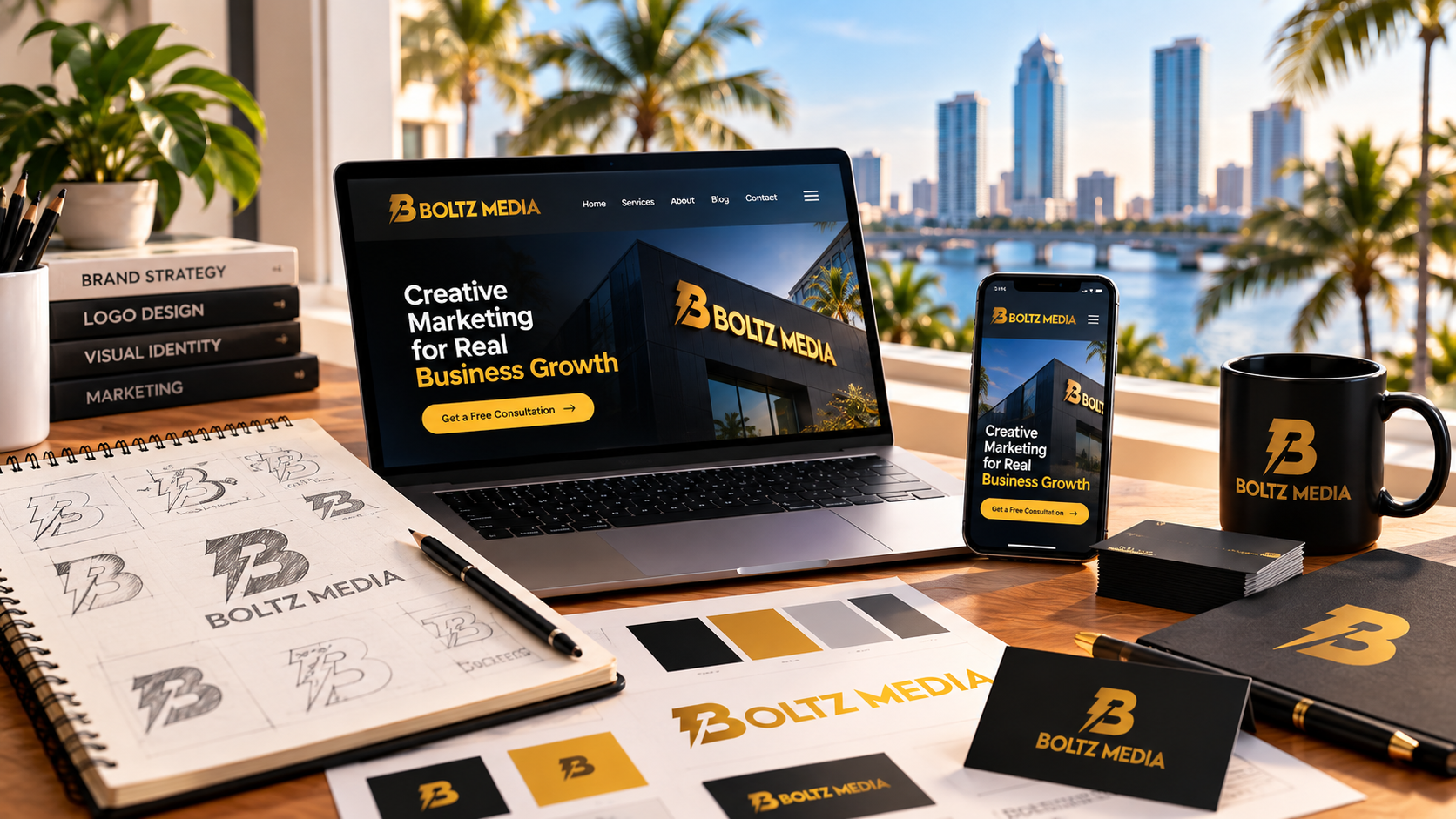
Professional logo design can influence how a Florida business presents itself, differentiates from competitors, and builds a consistent identity across its marketing channels. A well-planned logo gives a business a recognizable visual starting point for its website, social media, advertising, packaging, signage, and other customer touchpoints.
However, a logo does not grow a business by itself. Its value comes from how effectively it supports the overall brand strategy. For Florida businesses operating in competitive local and statewide markets, thoughtful logo design in Florida can help create a stronger visual foundation for long-term marketing and customer acquisition.
What Is Professional Logo Design?
A logo is more than a graphic placed beside a company name.
Professional logo design is the process of creating a visual identity that represents a business’s positioning, personality, audience, and market. It considers elements such as typography, symbols, proportions, colors, spacing, scalability, and how the logo will function across different platforms.
A professional approach begins by understanding the business before designing the visual identity.
For example, a residential service company may need a logo that feels dependable and straightforward, while a technology company may require a more modern and technical visual direction. A restaurant, healthcare business, real estate company, or professional service firm may each need a completely different visual language.
That is why effective logo design should start with business strategy rather than decoration.
1. A Logo Gives a Business a Clear Visual Starting Point
Many businesses begin with a name, service offering, and website but do not have a consistent visual identity.
This can make marketing materials look disconnected.
A properly designed logo gives the business a central visual element that can be used to establish a broader brand system.
It can influence:
- Website design
- Social media graphics
- Business cards
- Presentations
- Advertising creatives
- Email signatures
- Signage
- Vehicle graphics
- Product packaging
- Printed materials
Instead of creating every marketing asset independently, businesses can build them around a recognizable visual foundation.
This becomes especially useful as a business grows and adds new marketing channels.
2. Professional Logo Design Can Help a Business Stand Out
Florida has businesses competing across many industries, from home services and healthcare to real estate, hospitality, professional services, retail, and technology.
In competitive markets, customers may encounter several businesses offering similar services.
A generic visual identity can make it harder for a company to establish a distinct position.
Professional logo design gives a business an opportunity to develop a visual identity that reflects what makes it different.
The objective is not simply to create something attractive.
The logo should help answer a broader question:
Why should this business look different from its competitors?
A unique visual concept, appropriate typography, distinctive symbol, or carefully developed wordmark can contribute to that differentiation.
3. A Strong Logo Can Support Business Positioning
Business positioning describes how a company wants to be perceived in its market.
For example, a company may want to position itself as:
- Premium
- Innovative
- Reliable
- Approachable
- Experienced
- Local
- Specialized
- Professional
- Environmentally conscious
The logo should support that positioning.
A premium business may require a refined visual system, while a family-oriented business may benefit from a more approachable design.
This is where business logo design Florida becomes more strategic than simply choosing a symbol and font.
The visual identity should communicate an appropriate impression before the customer reads the entire website or marketing message.
4. Logo Design Can Strengthen Marketing Consistency
Businesses often use multiple platforms to reach customers.
A company may have:
- A website
- Google Business Profile
- Email marketing
- Google Ads
- Printed brochures
- Business signage
- Vehicle branding
Without a consistent visual identity, these channels can appear unrelated.
A properly designed logo helps establish a common visual element across them.
For example, the same logo can appear in a website header, social profile, advertising creative, email signature, and printed material.
This creates a more unified brand experience.
The logo is therefore not just a standalone design asset. It becomes one component of the company’s larger marketing system.
5. Custom Logo Design Can Reflect the Business’s Actual Audience
One of the biggest mistakes in logo creation is designing for the business owner instead of the customer.
A logo should be evaluated in the context of the audience it needs to attract.
Consider two businesses offering similar services.
One may target corporate clients, while another focuses on residential customers.
Although their services may overlap, their visual identities may need to communicate completely different messages.
Custom logo design Florida allows a business to develop an identity based on its specific market rather than relying on a generic template.
The design process can consider:
- Target audience
- Industry
- Service category
- Geographic market
- Customer expectations
- Competitor positioning
- Brand personality
- Business goals
This creates a more purposeful visual identity.
6. A Logo Needs to Work Beyond the Website
A common mistake is judging a logo only by how it looks on a desktop website.
Modern businesses use their identity in many formats.
A logo may appear on a small social media profile image one day and a large building sign the next.
It may also appear on:
- Mobile screens
- Business cards
- Uniforms
- Vehicle wraps
- Promotional materials
- Digital advertisements
- Documents
- Packaging
- Outdoor signage
A professionally designed logo should therefore be scalable and adaptable.
The design should remain recognizable whether it is displayed at a large size or reduced to a small digital icon.
7. Logo Design Can Improve the Foundation of Website Branding
A website is often one of the first major digital touchpoints between a business and a potential customer.
The logo contributes to the website’s visual hierarchy.
It can influence:
- Header design
- Color selection
- Typography
- Button styling
- Graphic direction
- Image treatment
- Brand presentation
This does not mean the entire website should simply copy the logo.
Instead, the website should extend the same visual language.
For businesses investing in website development, establishing the logo and broader brand identity early can make the design process more cohesive.
The result is a website that feels like an extension of the business rather than a separate marketing asset.
8. A Logo Can Make Digital Marketing Assets More Recognizable
Digital advertising is highly visual.
A customer may see a business advertisement while scrolling through social media, browsing a website, or searching Google.
The customer may not immediately read every word in the advertisement.
A consistent logo provides a visual identifier that connects the creative to the business.
Over time, repeatedly presenting the same visual identity across legitimate marketing touchpoints can help customers associate the design with the company.
This becomes particularly useful when businesses run multiple campaigns.
The logo acts as a consistent brand element while the campaign message, offer, imagery, and call to action change.
9. Professional Logo Design Can Support Social Media Branding
Social media requires businesses to create content frequently.
Without clear brand guidelines, individual posts can start looking unrelated.
A logo provides one anchor point for the visual identity.
For example, a business can develop social templates around:
- Logo placement
- Brand typography
- Supporting colors
- Photography style
- Graphic elements
- Icon styles
- Layout principles
This makes content production more organized.
It also allows different designers or marketing teams to create content without completely changing the brand’s appearance every time.
The logo therefore becomes part of a repeatable social media branding system.
10. A Logo Can Help Establish a Stronger Local Identity
Florida businesses often compete within specific communities while also serving customers beyond their immediate area.
A business might start locally and later expand into additional markets.
The logo should therefore avoid being so geographically restrictive that future expansion becomes difficult.
Instead of simply placing a city name inside the logo, businesses should consider whether their overall identity can represent the company as it grows.
For a Florida company, local relevance can be communicated through the broader brand strategy, photography, messaging, website content, customer experience, and marketing—not necessarily through a literal Florida symbol inside the logo.
This gives the brand more flexibility.
11. A Good Logo Creates a Reusable Brand Asset
Businesses continuously create marketing materials.
Every new campaign requires visual assets.
Every new social media channel needs profile graphics.
Every new location may need signage.
Every new advertising campaign needs creative variations.
A well-designed logo can be reused across all of these applications.
That makes it a long-term business asset rather than a one-time design purchase.
The goal should be to create an identity that remains useful as the company develops.
This is one reason businesses should think beyond how a logo looks today and consider where the brand could be several years from now.
12. Logo Design Should Work With the Business Name
Typography plays an important role in logo design.
The relationship between the business name and the visual mark can affect how easily customers recognize and read the brand.
Depending on the business, a logo might use:
- A wordmark
- A lettermark
- A symbol
- A combination mark
- An emblem
- A typographic treatment
There is no universal format that works for every company.
A professional designer should select a direction based on the business’s identity and practical requirements.
For example, a company with a short distinctive name may benefit from a strong wordmark, while a business with a longer name may require a symbol or abbreviated visual system for smaller applications.
13. A Logo Should Be Designed for Different Marketing Situations
Businesses rarely use only one version of their logo.
Different situations may require different formats while maintaining the same identity.
A complete logo system may include:
- Primary logo
- Secondary logo
- Icon or symbol
- Horizontal version
- Stacked version
- Light version
- Dark version
- Small-size variation
This creates flexibility without creating an inconsistent identity.
For example, the full logo might be used on a website header, while a simplified mark could be used for a social media profile.
The important point is that these variations should still belong to the same visual system.
14. Logo Design Can Support a Business as It Scales
Growth often introduces new requirements.
A company may hire employees, launch new services, expand into new markets, introduce products, or invest more heavily in advertising.
A weak logo can become restrictive as these changes happen.
A scalable identity gives the company greater flexibility.
For example, a business may eventually need:
Brand → Service → Location → Campaign
A well-developed identity can accommodate these different levels without requiring the company to create a completely new visual identity for every initiative.
This is particularly important for businesses planning long-term growth.
15. What Makes Effective Logo Design Different From a Generic Logo?
A logo can look visually appealing and still fail to serve the business.
Effective logo design should consider several practical questions:
Is it recognizable?
Customers should be able to identify the brand without unnecessary complexity.
Is it relevant?
The visual direction should make sense for the business and its audience.
Is it adaptable?
The identity should work across digital and physical applications.
Is it distinctive?
It should avoid looking like countless competitors.
Is it scalable?
The design should remain functional at different sizes.
Is it usable?
The logo should work in real marketing situations rather than only inside a presentation.
These factors make professional logo design a strategic business decision rather than simply an artistic exercise.
16. How Logo Design Works With a Broader Branding Strategy
A logo is only one part of branding.
A complete brand identity can include:
- Logo
- Color system
- Typography
- Photography direction
- Graphic elements
- Brand voice
- Messaging
- Website design
- Social media style
- Marketing materials
The logo establishes an important visual anchor, but the rest of the brand should support it.
This is why businesses should consider logo design as part of a broader branding strategy.
For Florida companies investing in professional logo design, the strongest outcome comes when the identity is connected to the company’s positioning, marketing, website, and customer experience.
17. When Should a Florida Business Invest in a New Logo?
Logo creation is particularly relevant when:
- Launching a new business
- Entering a new market
- Creating a new brand
- Expanding a service offering
- Moving from a small operation to a larger company
- Building a professional website
- Developing a complete brand identity
- Preparing for a major marketing campaign
A new business has an opportunity to establish its visual identity correctly from the beginning.
Existing businesses may also create a new logo when their current identity no longer represents their market or business direction.
That situation is different from a redesign. A new logo may involve creating the identity from the ground up rather than modifying an established mark.
18. How Businesses Should Approach Logo Design Before Starting
Before beginning the design process, businesses should clearly define what the logo needs to accomplish.
Start with five questions:
1. Who are we trying to reach?
Define the primary audience.
2. What do we want to communicate?
Identify the characteristics customers should associate with the business.
3. Who are our competitors?
Review competing brands to understand the visual environment.
4. Where will the logo be used?
Consider websites, social media, signage, vehicles, packaging, advertising, and print.
5. Where is the business going?
Think about future services, markets, locations, and growth.
These questions help turn logo creation into a strategic process.
19. What Is the Role of Logo Design in Long-Term Business Growth?
A logo does not directly generate leads, close sales, or replace marketing.
Instead, it supports the infrastructure around those activities.
A strong identity can make marketing more consistent.
Consistent marketing can create a clearer brand presence.
A clearer brand presence can help customers understand who they are interacting with.
And when the logo works alongside strong messaging, website design, advertising, social media, SEO, and customer experience, it becomes part of a larger growth system.
This distinction is important.
Businesses should not expect a logo alone to create growth.
They should use the logo as one of the foundational assets supporting the marketing strategy.
Logo Design vs. Logo Redesign
Logo design and logo redesign serve different purposes.
Logo design generally involves creating a visual identity for a new brand or developing a new identity from the ground up.
Logo redesign involves modifying or updating an existing identity while considering its existing recognition and brand history.
For example, a new Florida business launching for the first time may need custom logo design Florida to establish its identity.
An established company with years of market presence may instead evaluate whether its existing logo requires a redesign.
Understanding this difference helps businesses choose the right branding approach.
Common Logo Design Mistakes
Designing for personal preference
The logo should represent the business and audience—not simply the owner’s favorite colors or styles.
Copying competitors
Competitor research is useful, but copying their visual identity makes differentiation more difficult.
Making the logo too complicated
Excessive detail can create problems when the logo is reduced for mobile or social media.
Designing only for one platform
A logo created only for a website may not work on signage, vehicles, documents, or social profiles.
Ignoring scalability
A logo should be tested at both large and small sizes.
Treating the logo as the entire brand
A logo is an important component of branding, but it needs supporting messaging, visuals, and customer experience.
Following trends too closely
Design trends change. A business identity should be able to remain useful beyond a short trend cycle.
How Boltz Media Approaches Branding and Logo Design
A logo should begin with understanding the business.
At Boltz Media, branding can connect visual identity with the broader digital presence of a business rather than treating the logo as an isolated graphic.
The process can consider the company’s audience, positioning, digital presence, marketing requirements, and future growth.
The objective is to create a brand identity that can work across websites, social media, advertising, business materials, and other customer touchpoints.
For businesses looking for logo design Florida services, this broader approach can create a stronger connection between branding and digital marketing.
Explore Boltz Media Branding Services
FAQs
Does a professional logo really matter for a small business?
Yes. A professional logo gives a small business a structured visual identity that can be used consistently across its website, social media, advertising, signage, and other marketing materials.
How is custom logo design different from a template logo?
Custom logo design is developed around the specific business, audience, positioning, and practical requirements. Template-based logos generally start from pre-existing visual structures that may also be used by other businesses.
Should a Florida business include Florida in its logo?
Not necessarily. A business can communicate its Florida market through branding, messaging, photography, website content, and marketing without permanently restricting the logo to one geographic identity.
Can a logo help with digital marketing?
A logo can support digital marketing by providing a consistent visual identifier across websites, social media, advertising, email, and other digital channels.
Should a new business create its logo before building its website?
Ideally, the visual identity should be established early because it can influence website branding, typography, colors, graphics, and other design decisions.
Does a logo guarantee business growth?
No. A logo is one component of a broader business and marketing strategy. Growth also depends on factors such as the product or service, positioning, website, SEO, advertising, sales process, customer experience, and retention.
Final Takeaway
Professional logo design can give a Florida business a stronger visual foundation for growth.
The value of a logo is not simply whether it looks attractive. Its real value comes from how effectively it represents the business, differentiates the company, supports its positioning, and works consistently across marketing channels.
For a new or growing company, investing in logo design Florida can be an important first step toward building a complete brand identity.
When the logo is developed alongside website design, digital marketing, social media, advertising, and other branding elements, it becomes more than a graphic—it becomes a reusable business asset that supports the company’s long-term marketing system.