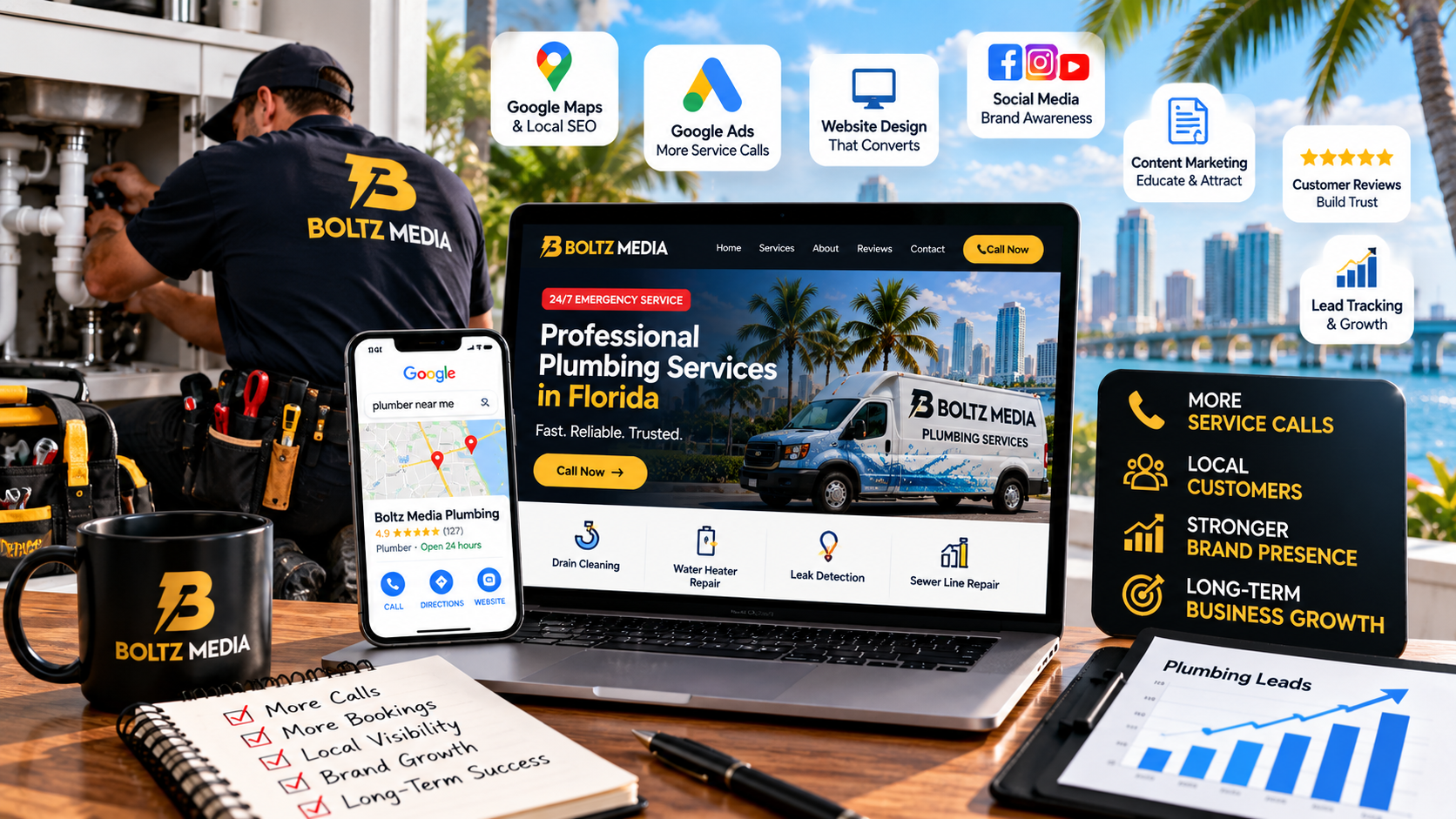
Plumbing is a highly local business, and customers often search online when they need information about a plumbing problem or are ready to find a service provider.
A homeowner may search for information about a leaking water heater, clogged drain, low water pressure, or sewer problem. Another customer may immediately search for a plumber serving their area.
This makes digital marketing an important part of how plumbing companies can build visibility and communicate with potential customers.
But digital marketing is much broader than simply ranking a website or running advertisements.
For plumbing companies, it can include website development, Local SEO, Google Business Profile optimization, search advertising, content marketing, social media, online reviews, email marketing, and customer retention.
Understanding how these channels work—and how they complement each other—can help plumbing companies make better marketing decisions.
What Is Digital Marketing for Plumbers?
Digital marketing for plumbers refers to using online channels to help people discover, research, evaluate, and communicate with a plumbing business.
These channels can include:
- Business websites
- Search engines
- Google Business Profile
- Local SEO
- Google Ads
- Social media
- Educational content
- Online reviews
- Email marketing
- Retargeting
- Online directories
Each channel serves a different purpose.
For example, Local SEO can help customers discover a business through local search, while educational content can answer questions before someone is ready to hire a plumber.
Social media can introduce people to the company, while a website can provide detailed service information.
The objective is therefore not to treat every channel as a separate marketing activity. Instead, businesses can understand how the channels work together throughout the customer journey.
Why Is Digital Marketing Important for Plumbing Companies?
Plumbing is different from many industries because customers may search for a business at very different stages.
Someone might be researching a plumbing problem several weeks before contacting a professional.
Another person may need emergency assistance immediately.
Consider searches such as:
- Why does my drain keep clogging?
- How often should a water heater be serviced?
- What causes low water pressure?
- How do I know if I have a water leak?
- What is involved in sewer line repair?
- Emergency plumber near me
- Water heater repair service
The first group is primarily looking for information.
The second group may already be looking for a service provider.
A well-rounded digital marketing strategy should be able to support both types of search behavior.
Understanding the Plumbing Customer Journey
Digital marketing becomes easier to understand when viewed as a customer journey.
A potential customer may move through several stages:
1. Awareness
The person realizes there is a plumbing problem or has a question.
2. Research
They search for information about the problem and possible solutions.
3. Evaluation
They begin comparing businesses, reviews, services, experience, and availability.
4. Decision
They contact a plumbing company or request an appointment.
5. Experience
The customer receives the service.
6. Retention
The business stays connected through appropriate follow-up, maintenance reminders, or future service needs.
Different digital channels can support different stages of this journey.
1. A Plumbing Website Is the Foundation of the Digital Presence
A website is often the central location where customers can learn about a plumbing company.
Unlike a social media profile or business listing, the website gives the company greater control over how information is organized and presented.
A plumbing website can explain:
- Services
- Service areas
- Company background
- Experience
- Process
- Frequently asked questions
- Customer reviews
- Contact information
- Educational resources
A well-structured website should also make important information easy to find on mobile devices.
What Should a Plumbing Website Include?
A typical structure might include:
Homepage
→ Company overview and primary services
Service Pages
→ Drain cleaning
→ Water heater services
→ Leak detection
→ Sewer services
→ Emergency plumbing
About Page
→ Company background and experience
Service Area Pages
→ Genuine areas served
Resources
→ Helpful plumbing information
Contact Page
→ Contact and appointment options
The exact structure should depend on the company’s services and customers.
2. Local SEO Helps Customers Find Plumbing Businesses
Local SEO is one component of plumbing digital marketing.
It focuses on improving a business’s visibility for searches connected to its geographic market.
Important elements can include:
- Google Business Profile
- Accurate business information
- Service information
- Service-area information
- Relevant website content
- Internal linking
- Online reviews
- Local citations
- Mobile usability
The purpose is to make it easier for customers and search engines to understand:
What does the company do?
Where does it operate?
Which services does it provide?
Local SEO should not be viewed as simply adding city names to website pages.
Useful local information should reflect the company’s genuine operations.
3. Google Business Profile and Local Discovery
Google Business Profile is an important part of local online visibility.
A plumbing company’s profile can provide customers with information such as:
- Business name
- Category
- Services
- Phone number
- Website
- Hours
- Service areas
- Photos
- Reviews
Keeping this information accurate is important because customers often use business listings to evaluate a company before visiting its website.
Photos can also provide useful context about the business, team, equipment, vehicles, facilities, or completed work.
The profile should represent the actual business rather than being treated as another place to insert keywords.
4. Content Marketing Can Answer Plumbing Questions
Not every customer starts with a service search.
Many begin with a question.
For example:
Water Heater Questions
- Why is my water heater leaking?
- How long does a water heater typically last?
- What are signs that a water heater needs attention?
Drain Questions
- Why does a drain keep clogging?
- What causes slow drainage?
- When should a drain problem be professionally inspected?
Plumbing Maintenance Questions
- How can plumbing problems be identified early?
- What should homeowners check regularly?
- What plumbing problems commonly require professional attention?
Educational content can help businesses explain these topics.
The purpose should be to provide useful information rather than turning every article into a sales page.
This is particularly important for informational searches.
5. Educational Content Can Build Expertise
A plumbing company has practical knowledge that customers may not have.
That knowledge can be converted into useful educational content.
Examples include:
- Plumbing maintenance guides
- Troubleshooting articles
- Service explanations
- Frequently asked questions
- Seasonal plumbing advice
- Homeowner checklists
- Commercial plumbing resources
- Maintenance recommendations
For example, instead of creating an article simply targeting “plumber Florida,” a company could explain:
“What Are the Most Common Causes of Low Water Pressure?”
The article can explain possible causes, warning signs, and when professional inspection may be appropriate.
This creates a resource that provides value even before the reader becomes a customer.
6. Google Ads Can Reach High-Intent Searches
Google Ads serve a different purpose from organic search.
Paid advertising can help businesses appear when people are actively searching for specific services.
Examples might include:
- Emergency plumbing
- Water heater repair
- Drain cleaning
- Sewer repair
- Leak detection
- Commercial plumbing
However, advertising should not be treated as simply paying for clicks.
Businesses need to consider:
- Search intent
- Keyword relevance
- Geographic targeting
- Ad messaging
- Landing pages
- Conversion tracking
- Budget
- Lead quality
For example, an advertisement for water heater repair should ideally take the visitor to information specifically related to water heater services rather than an unrelated page.
7. Landing Pages and Service Pages Have Different Roles
Service pages and landing pages can look similar, but their purposes may differ.
A service page can provide comprehensive information about a particular service and remain part of the website’s long-term structure.
A landing page may be designed specifically around a campaign, advertisement, or particular audience.
Both should clearly communicate:
- What the service is
- Who it is for
- What the process involves
- Where the service is available
- What customers should know
- How to take the next step
The content should match the visitor’s intent.
8. Social Media Can Build Brand Familiarity
Social media is not necessarily the place where every plumbing customer will immediately make a service decision.
Its role can be broader.
Plumbing companies can use social platforms to share:
- Maintenance tips
- Educational videos
- Project examples
- Before-and-after work
- Team introductions
- Frequently asked questions
- Seasonal advice
- Behind-the-scenes content
This helps people become familiar with the company.
For example, someone may see several useful plumbing tips from a company over time and later remember that business when they need professional assistance.
This makes social media particularly useful for brand familiarity and awareness.
9. Online Reviews Help Customers Evaluate Businesses
Reviews are another important part of a plumbing company’s digital presence.
Before contacting an unfamiliar business, customers may look at previous customer experiences.
Reviews can provide insight into areas such as:
- Communication
- Reliability
- Professionalism
- Quality of work
- Responsiveness
- Overall customer experience
A company should focus on collecting genuine customer feedback rather than simply trying to increase the review count.
It can also be useful to identify recurring themes in reviews.
For example, if customers frequently mention clear communication or punctual service, those comments can help future customers understand the company’s strengths.
10. Retargeting Can Reconnect With Previous Website Visitors
Not every website visitor will contact a company during their first visit.
A visitor may:
- Read a service page
- Compare several companies
- Leave the website
- Continue researching
- Return later
Retargeting can help businesses reconnect with previous website visitors through appropriate advertising platforms.
However, it should be used carefully.
Businesses should consider privacy requirements, platform policies, frequency limits, and whether the advertising actually provides value.
Retargeting should support the customer journey rather than simply showing the same advertisement repeatedly.
11. Email and SMS Can Support Customer Retention
Digital marketing is not limited to finding new customers.
Existing customers may also have future service needs.
With appropriate permission and compliance, businesses can use email or SMS for:
- Appointment reminders
- Maintenance reminders
- Follow-up communication
- Seasonal information
- Service reminders
- Customer updates
For example, a customer who previously received a plumbing service may later need maintenance or another related service.
A retention strategy helps maintain the relationship instead of treating every customer interaction as a completely new lead.
12. Residential and Commercial Plumbing Need Different Marketing Approaches
Not all plumbing customers have the same priorities.
Residential Customers
Homeowners may be particularly interested in:
- Availability
- Response time
- Trust
- Reviews
- Convenience
- Service information
- Emergency assistance
Commercial Customers
Commercial buyers may evaluate:
- Experience
- Reliability
- Project capabilities
- Service agreements
- Response times
- Compliance
- References
- Long-term support
Because of these differences, digital marketing for plumbing companies should reflect the audience being targeted.
The same website messaging may not be appropriate for both residential homeowners and commercial decision-makers.
13. Branding Is Part of Digital Marketing
Digital marketing is not only about search rankings and advertisements.
Brand recognition also matters.
A plumbing company may appear through:
- Website
- Google Business Profile
- Search advertisements
- Social media
- Service vehicles
- Business cards
- Uniforms
- Customer communications
A consistent identity across these touchpoints can make the business easier to recognize.
Important elements include:
- Logo
- Colors
- Typography
- Photography
- Messaging
- Tone of voice
This is where plumbing company marketing can combine brand development with customer acquisition.
14. Why Marketing Channels Should Work Together
One of the biggest advantages of a broader digital marketing strategy is that different channels can support one another.
Consider this example:
Educational Content → Organic Search → Service Page → Contact
Another:
Social Media → Website → Educational Content → Brand Familiarity
Another:
Google Ads → Service Landing Page → Inquiry
And another:
Completed Job → Review → Google Business Profile → New Customer
These are not separate systems.
They can form one connected digital ecosystem.
15. Measuring Digital Marketing Performance
Digital marketing should be measured according to the goals of the business.
Useful metrics may include:
Website Metrics
- Organic traffic
- Landing-page visits
- Engagement
- Service-page views
Search Metrics
- Search visibility
- Local search performance
- Google Business Profile interactions
Advertising Metrics
- Clicks
- Cost per click
- Conversion rate
- Cost per lead
Business Metrics
- Phone calls
- Form submissions
- Bookings
- Qualified leads
- Completed jobs
- Repeat customers
Traffic alone does not tell the complete story.
A smaller number of relevant visitors can sometimes be more valuable than a large amount of unrelated traffic.
16. How to Create a Digital Marketing Strategy for a Plumbing Company
There is no single marketing channel that every plumbing business needs to prioritize first.
A useful planning process is to start with the basics.
Step 1: Understand the Business
Identify:
- Primary services
- Customer types
- Service areas
- Competitive advantages
- Business goals
Step 2: Understand the Customers
Identify:
- Common problems
- Search behavior
- Questions
- Buying concerns
- Reasons customers choose one company over another
Step 3: Build the Website Foundation
Make sure the website clearly communicates the services, business information, and service areas.
Step 4: Establish Local Visibility
Develop the Google Business Profile and Local SEO foundation.
Step 5: Create Educational Content
Answer real customer questions and explain important plumbing topics.
Step 6: Add Paid Advertising Where Appropriate
Use Google Ads or other advertising channels when there is a clear business case.
Step 7: Build Brand Familiarity
Use social media, content, reviews, and consistent branding.
Step 8: Measure and Improve
Review performance and adjust the strategy based on actual results.
17. Common Digital Marketing Mistakes for Plumbing Companies
Relying on Only One Channel
Depending entirely on SEO, advertising, or social media can make a business overly dependent on one source of visibility.
Creating Content Only for Keywords
Content should answer real customer questions rather than simply repeating keywords.
Ignoring the Website Experience
Generating traffic is less useful when visitors cannot find the information they need.
Using Duplicate Location Pages
Changing a city name while keeping nearly identical content does not create meaningful local resources.
Ignoring Reviews
Online reputation can influence how customers evaluate unfamiliar businesses.
Not Understanding Search Intent
An informational search and an emergency service search represent different customer needs.
Measuring Only Traffic
Traffic is useful, but businesses should also understand whether visitors are relevant and whether marketing contributes to meaningful outcomes.
Treating Every Customer the Same
Residential homeowners and commercial buyers may have different expectations and decision-making processes.
Commercial Considerations: When Should a Plumbing Company Invest in Digital Marketing?
Digital marketing may become especially useful when a plumbing company wants to:
- Improve online visibility
- Enter a new service area
- Promote specific services
- Build stronger brand recognition
- Improve its website
- Generate more qualified inquiries
- Reach customers through multiple channels
- Better understand where leads come from
The right marketing mix depends on the company’s current digital presence, competition, service area, budget, and business objectives.
There is no universal requirement to use every channel.
A company may benefit from strengthening its website and Local SEO first, while another may have a strong organic presence and need better advertising or conversion tracking.
How Boltz Media Can Support Plumbing Digital Marketing
For plumbing companies that need help coordinating multiple digital channels, a broader marketing approach can bring website development, Local SEO, advertising, social media, content, and conversion strategy together.
Boltz Media’s Digital Marketing services can support Florida businesses with strategies that may include:
- Digital marketing strategy
- Local SEO
- Website development
- Online advertising
- Social media
- Content marketing
- Conversion optimization
- Lead tracking
- Branding
The appropriate combination depends on the business and its goals.
For example, a company starting from an outdated website may need to establish its website and Local SEO foundation before expanding into more advertising channels.
A business with an established online presence may instead focus on improving campaign performance, content, conversion tracking, or customer retention.
Frequently Asked Questions
What is digital marketing for plumbers?
Digital marketing for plumbers involves using online channels such as websites, search engines, Google Business Profile, advertising, content, social media, reviews, email, and other digital platforms to communicate with potential and existing customers.
Why is digital marketing important for plumbing companies?
It can help plumbing companies become more visible when customers search for information or services, while also providing ways to explain their expertise, services, and customer experience.
Is Local SEO part of plumbing digital marketing?
Yes. Local SEO is one component of a broader digital marketing strategy and focuses on improving visibility for relevant local searches.
Do plumbers need a website?
A website provides a central location for service information, company details, educational content, reviews, and contact options. The complexity of the website should depend on the company’s needs.
Should plumbing companies use Google Ads?
Google Ads can be useful when a company wants to reach people actively searching for particular services. The decision should consider budget, competition, search demand, landing pages, and lead quality.
What type of content should plumbing companies publish?
Useful content can include maintenance guides, plumbing explanations, frequently asked questions, troubleshooting information, seasonal advice, service explanations, and educational resources.
Are social media platforms useful for plumbers?
They can be useful for building familiarity, sharing educational content, showcasing work, and maintaining communication with an audience. Their role may differ from search and advertising channels.
How long does digital marketing take to produce results?
There is no universal timeline. Paid advertising can provide visibility relatively quickly, while organic search, content, brand recognition, and reputation-building generally require ongoing work.
Final Takeaway
Digital marketing for plumbers is not limited to SEO or advertising.
It is a broader system that can connect:
Website + Local SEO + Google Business Profile + Content + Advertising + Social Media + Reviews + Customer Retention
Each channel serves a different purpose.
Some help customers discover a plumbing company. Others answer questions, build trust, explain services, or maintain relationships with existing customers.
For Florida plumbing companies, the most useful approach is not necessarily to use every available marketing channel. It is to understand how customers search, what information they need, and which digital channels are appropriate at each stage of the customer journey.
When the different parts of digital marketing support one another, a plumbing company can build a more useful, recognizable, and sustainable online presence.