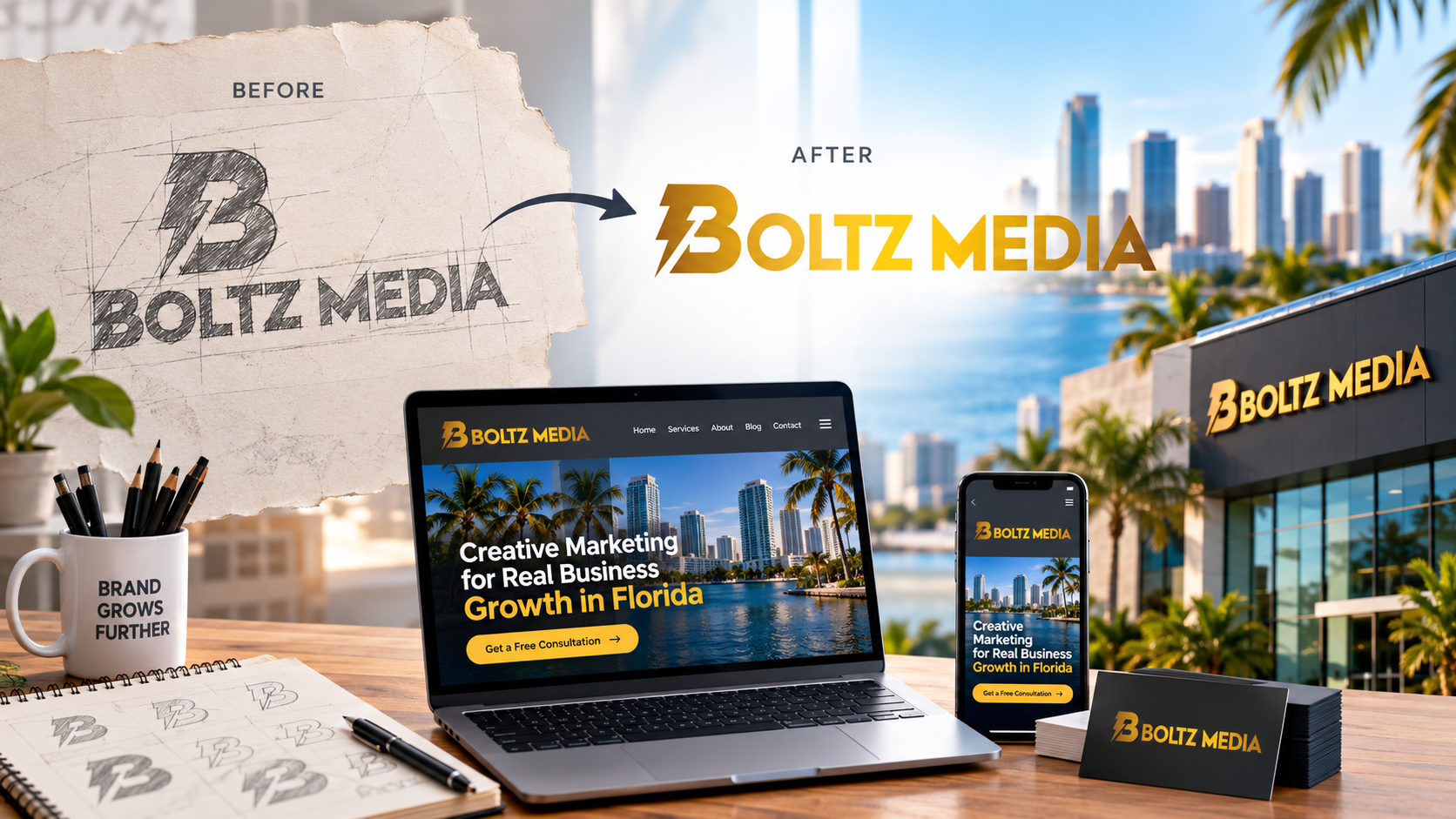
A logo redesign can affect how customers recognize, remember, and perceive a business. A dated, inconsistent, or difficult-to-use logo can make an established company appear less relevant, while a thoughtful redesign can create a stronger visual identity across websites, social media, advertising, packaging, signage, and other customer touchpoints.
For Florida businesses, a logo redesign should not be treated simply as changing an image. It should support the company’s positioning, target audience, services, market, and long-term brand identity.
A successful redesign typically keeps the recognizable elements that have value while improving areas such as typography, color, scalability, visual balance, and consistency.
What Is a Logo Redesign?
A logo redesign is the process of improving or updating an existing business logo while considering the identity and recognition the original design has already established.
It is different from creating a logo for a completely new business.
A new business may be starting with a blank canvas. An established company already has customers who may associate certain colors, shapes, symbols, or typography with its brand.
That creates an important challenge.
The redesigned logo should feel new enough to improve the brand but familiar enough to preserve recognition.
Depending on the situation, a redesign may involve:
- Updating typography
- Simplifying a complex symbol
- Refining colors
- Improving proportions
- Modernizing an icon
- Removing outdated design elements
- Creating responsive logo variations
- Improving readability
- Developing a complete visual identity around the logo
The extent of the redesign should depend on the actual problems with the existing brand.
Why Would a Florida Business Need a Logo Redesign?
Businesses change over time.
A company that started several years ago may now have different services, customers, markets, or business goals.
The original logo may no longer represent the company accurately.
Common reasons for a redesign include:
- The logo looks outdated
- The design is difficult to read
- The logo does not work well on mobile devices
- The company has expanded its services
- The target audience has changed
- The business has entered new markets
- Branding is inconsistent across platforms
- The logo looks unprofessional compared with competitors
- The business has undergone a larger rebrand
- The existing design does not work well in digital advertising
For example, a Florida home-service company may have started with a basic logo designed primarily for a truck or physical sign.
Years later, the same company may need that logo to work across a website, Google Business Profile, social media profile, video content, paid advertising, uniforms, vehicles, and mobile screens.
A redesign can help create a more flexible visual identity.
1. A Logo Redesign Can Improve Brand Recognition
Recognition is one of the most important functions of a business logo.
Customers may encounter a company in several different places before becoming a customer:
- Google Search
- Website
- Social media
- Digital advertisements
- Business directories
- Vehicles
- Storefronts
- Printed materials
- Videos
A consistent logo helps connect these different interactions to the same business.
However, redesigning a logo does not automatically improve recognition.
The redesign should preserve useful elements of the existing identity where appropriate.
For example, if customers strongly associate a company with a particular symbol or color, completely removing those elements may make the new brand harder to recognize.
A strategic business logo redesign evaluates what should stay, what should change, and why.
2. A Modern Logo Can Strengthen Customer Perception
Customers often form an initial impression of a company before contacting it.
Visual identity can influence whether a business appears:
- Professional
- Established
- Modern
- Trustworthy
- Premium
- Approachable
- Innovative
- Reliable
This does not mean a sophisticated logo can compensate for poor service.
It cannot.
But when a company’s service quality and branding are aligned, a professional visual identity can reinforce the overall customer experience.
For example, a Florida professional-services company targeting commercial clients may need a different visual direction from a casual consumer-focused brand.
The logo should reflect the company’s actual positioning rather than simply following a design trend.
3. Logo Redesign Can Improve Digital Visibility and Usability
Modern logos need to work across many screen sizes.
A logo that looks good on a large sign may become difficult to recognize when reduced to:
- A website header
- A mobile screen
- A social media profile
- A Google Business Profile image
- An online advertisement
- A video watermark
- An email signature
This is why scalability should be considered during a redesign.
A professional logo system may include variations such as:
- Primary logo
- Horizontal logo
- Stacked logo
- Icon or symbol
- Light-background version
- Dark-background version
- Small-format version
The objective is not to create unnecessary versions.
It is to make sure the brand remains recognizable in the environments where customers actually see it.
4. A Redesign Can Create Greater Brand Consistency
A common problem for growing businesses is inconsistent branding.
The website may use one version of the logo.
Social media may use another.
An advertisement may use different colors.
Business cards may contain an older logo.
A company vehicle may display a different variation.
Over time, these inconsistencies can make the business appear less organized.
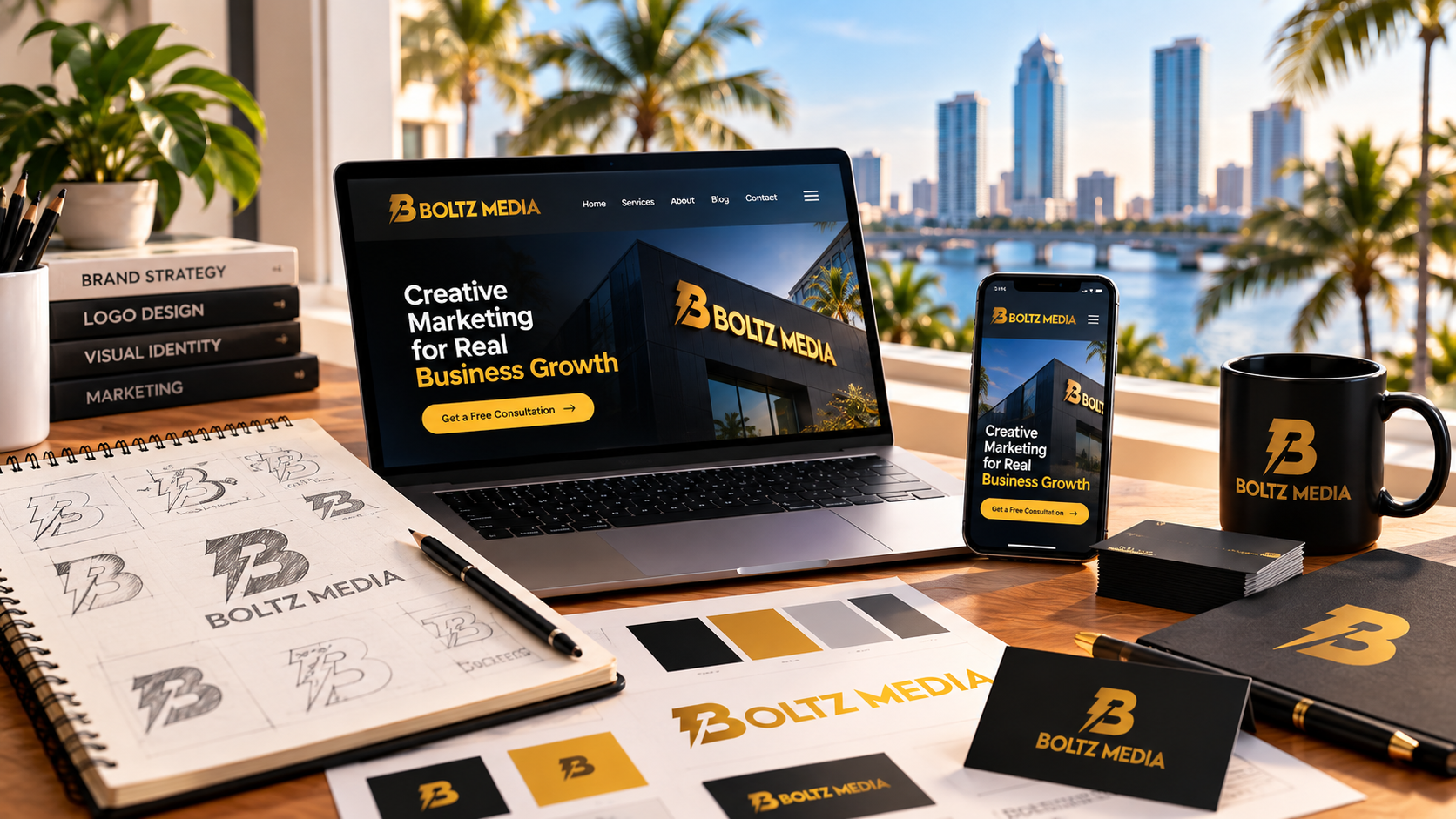
A logo redesign can become an opportunity to establish clearer brand guidelines covering:
- Logo usage
- Colors
- Typography
- Spacing
- Image style
- Graphic elements
- Social media presentation
This gives different marketing channels a common visual foundation.
For a business investing in logo redesign services in Florida, the logo should be considered part of the broader brand identity rather than an isolated graphic.
5. When Should a Business Redesign Its Logo?
Not every business needs a new logo.
A redesign makes more sense when the existing identity creates a genuine business or communication problem.
Consider a redesign if:
Your Logo Looks Outdated
Design styles change, and an identity created many years ago may no longer communicate the company’s current positioning.
Your Logo Is Difficult to Use Digitally
If the logo becomes unreadable on mobile screens or social media profiles, it may need simplification.
Your Business Has Changed
A company that has expanded its services or entered a new market may need its visual identity to reflect its current direction.
Your Branding Is Inconsistent
If multiple versions of the logo are being used, a redesign can help establish a more consistent system.
Your Target Audience Has Changed
The visual identity that worked for an early customer base may not communicate effectively with the company’s current audience.
Your Competitors Look More Professional
This alone is not a sufficient reason to redesign.
However, if your visual identity no longer communicates the quality or positioning of your business, it may be worth evaluating.
6. Logo Redesign Does Not Mean Starting From Zero
One of the biggest mistakes businesses make is assuming that a redesign should completely erase the previous identity.
A successful redesign may be evolutionary rather than revolutionary.
For example, designers might:
- Refine an existing symbol
- Simplify typography
- Adjust proportions
- Modernize colors
- Improve spacing
- Remove unnecessary details
- Create a cleaner digital version
This approach can preserve valuable brand equity while improving usability.
A complete visual transformation may be appropriate for some businesses, but it should be based on a clear strategic reason.
7. How Logo Redesign Affects Website Design
Your logo and website should work as one visual system.
A redesigned logo may require updates to:
- Website header
- Navigation
- Color palette
- Buttons
- Typography
- Favicon
- Footer
- Images
- Landing pages
- Social media graphics
This is especially important when the company is undergoing a broader brand update.
For example, if a Florida business changes from a traditional visual identity to a more modern brand, simply replacing the logo on an old website may create a visual mismatch.
The website may still use the old typography, colors, photography style, and layout.
A stronger approach is to evaluate the entire digital experience.
This is where Web Design services in Florida can complement a broader branding project.
8. How a Logo Redesign Supports Social Media Marketing
Social media is highly visual.
Customers may recognize a company from a profile image, Reel, post, advertisement, or video before they ever visit its website.
A consistent logo helps create visual continuity across platforms such as:
- YouTube
- Other relevant business profiles
However, the logo should not dominate every social media graphic.
Strong social media branding combines the logo with:
- Consistent colors
- Typography
- Photography
- Graphic styles
- Video presentation
- Brand voice
This creates a recognizable brand rather than simply placing a logo on every post.
9. Logo Redesign Can Support Advertising and Marketing
A business may use its logo across:
- Google Ads landing pages
- Display advertising
- Social media ads
- Email campaigns
- Video advertisements
- Promotional materials
- Printed marketing
A logo that is clear and recognizable at different sizes can create stronger visual consistency between the advertisement and the destination page.
For example, if someone clicks an advertisement and arrives at a website using a completely different visual identity, the experience can feel disconnected.
Brand consistency helps create continuity from the first impression to the conversion point.
10. Florida Businesses Should Consider Their Market Positioning
A logo should communicate the business rather than simply communicate its location.
Adding a Florida-related icon does not automatically make a logo more effective.
A business serving Florida customers should first consider:
- Who its customers are
- What services it provides
- What makes it different
- Whether it targets consumers or businesses
- Whether it is positioned as affordable, premium, technical, professional, or approachable
- Whether the brand needs to work beyond one local market
For example, a Florida roofing company may want to communicate reliability and expertise rather than relying on obvious palm-tree imagery.
A commercial technology company serving clients across Florida may require a more technical and professional visual identity.
The location can influence brand context, but it does not need to dominate the logo.
11. What Should You Consider Before a Logo Redesign?
Before changing the design, businesses should answer several questions.
What Is Wrong With the Current Logo?
Identify the actual problem.
Is it outdated, difficult to read, inconsistent, or no longer aligned with the business?
What Should Customers Feel?
Should the brand appear:
- Professional?
- Trustworthy?
- Premium?
- Modern?
- Friendly?
- Innovative?
Who Is the Target Audience?
A logo should be designed for the customers the company wants to attract.
Where Will the Logo Be Used?
Consider:
- Website
- Mobile
- Social media
- Vehicles
- Signage
- Advertising
- Video
What Brand Equity Should Be Preserved?
Identify colors, symbols, or design elements customers already recognize.
12. What Makes a Professional Logo Redesign Effective?
A professional logo redesign generally balances several principles.
Simplicity
The logo should be recognizable without unnecessary complexity.
Relevance
The design should make sense for the business and its audience.
Scalability
It should remain usable from a large sign to a small mobile icon.
Distinctiveness
The design should help differentiate the business from competitors.
Consistency
The logo should work with the broader brand identity.
Longevity
Avoid designing entirely around a temporary trend.
The objective is to create an identity that can remain useful as the company grows.
13. Logo Redesign vs. Rebranding: What’s the Difference?
These terms are often confused.
Logo Redesign
Focuses primarily on improving or updating the logo.
Rebranding
Can involve a much broader change to the company’s identity and positioning.
A rebrand may include:
- New brand strategy
- New messaging
- New positioning
- New logo
- New colors
- New typography
- New website
- New marketing materials
- New customer experience
A company may need only a logo redesign rather than a complete rebrand.
The right approach depends on the problem the business is trying to solve.
14. How to Plan a Logo Redesign Without Losing Recognition
A structured process can reduce unnecessary disruption.
Step 1: Audit the Existing Identity
Review where and how the current logo is being used.
Step 2: Identify What Works
Determine which elements have recognition or customer value.
Step 3: Define the Brand Direction
Clarify the audience, positioning, personality, and business goals.
Step 4: Develop Design Concepts
Create multiple directions based on the agreed strategy.
Step 5: Test Practical Applications
Check the logo on:
- Website
- Mobile
- Social media
- Business cards
- Signage
- Vehicles
- Marketing materials
Step 6: Create Brand Guidelines
Document how the final logo should be used.
Step 7: Update Digital Assets
Replace outdated versions across important business channels.
This process helps make the redesign a business decision rather than simply a visual exercise.
How Much Does a Logo Redesign Cost?
There is no universal price for logo redesign.
Cost can vary depending on:
- Complexity
- Number of concepts
- Research involved
- Number of revisions
- Brand guidelines
- Additional visual assets
- Website requirements
- Business size
- Scope of the project
A simple logo update is different from a complete visual identity project.
Businesses should therefore evaluate the scope and deliverables rather than comparing prices based only on the logo itself.
Common Logo Redesign Mistakes
Changing the Logo Without a Strategy
A redesign should solve a real business or communication problem.
Following Trends Too Closely
A design that looks fashionable today may quickly feel outdated.
Removing All Existing Brand Recognition
Established brands should consider which elements customers already associate with the business.
Designing Only for One Platform
The logo should work across digital and physical environments.
Ignoring the Website
A new logo can look disconnected if the rest of the brand remains unchanged.
Using Too Many Design Elements
Complexity can reduce recognition, particularly at smaller sizes.
Copying Competitors
A business needs its own visual identity rather than a variation of another company’s branding.
Frequently Asked Questions
How often should a business redesign its logo?
There is no fixed schedule. A business should consider redesigning when its existing logo no longer represents its positioning, audience, services, or modern digital requirements.
Is a logo redesign the same as a rebrand?
No. A logo redesign focuses on the visual mark, while a rebrand can involve the company’s broader identity, messaging, positioning, website, and customer experience.
Will changing a logo hurt brand recognition?
It can if valuable existing brand elements are removed without considering customer recognition. A strategic redesign can instead modernize the identity while preserving important visual associations.
Should a Florida business include Florida imagery in its logo?
Not necessarily. A Florida business does not need a palm tree, state outline, beach, or similar symbol. The design should primarily reflect the company’s positioning and audience.
Can a logo redesign improve digital marketing?
Yes, when the redesigned identity improves consistency across the website, social media, advertising, email, video, and other marketing channels.
Should a logo be redesigned for social media?
The main logo does not necessarily need a separate redesign, but businesses may benefit from responsive variations or simplified versions that remain recognizable at small sizes.
What should a business do after redesigning its logo?
Update important digital and physical brand assets, including the website, social profiles, advertisements, email signatures, business materials, signage, vehicles, and other customer-facing applications.
Final Takeaway
A logo redesign is more than changing colors, fonts, or an icon.
For an established Florida business, it can be an opportunity to strengthen recognition, improve digital usability, create consistent branding, and align the visual identity with the company’s current market position.
The most effective logo redesign Florida strategy starts with understanding what already works, identifying what needs improvement, and creating an identity that can perform across websites, mobile devices, social media, advertising, video, and physical marketing.
A strong logo should not simply look modern.
It should help customers recognize the business, understand its positioning, and remember it across different points of the customer journey.
For businesses considering a broader brand update, combining professional branding with a modern website and consistent digital marketing can create a stronger foundation for long-term growth.