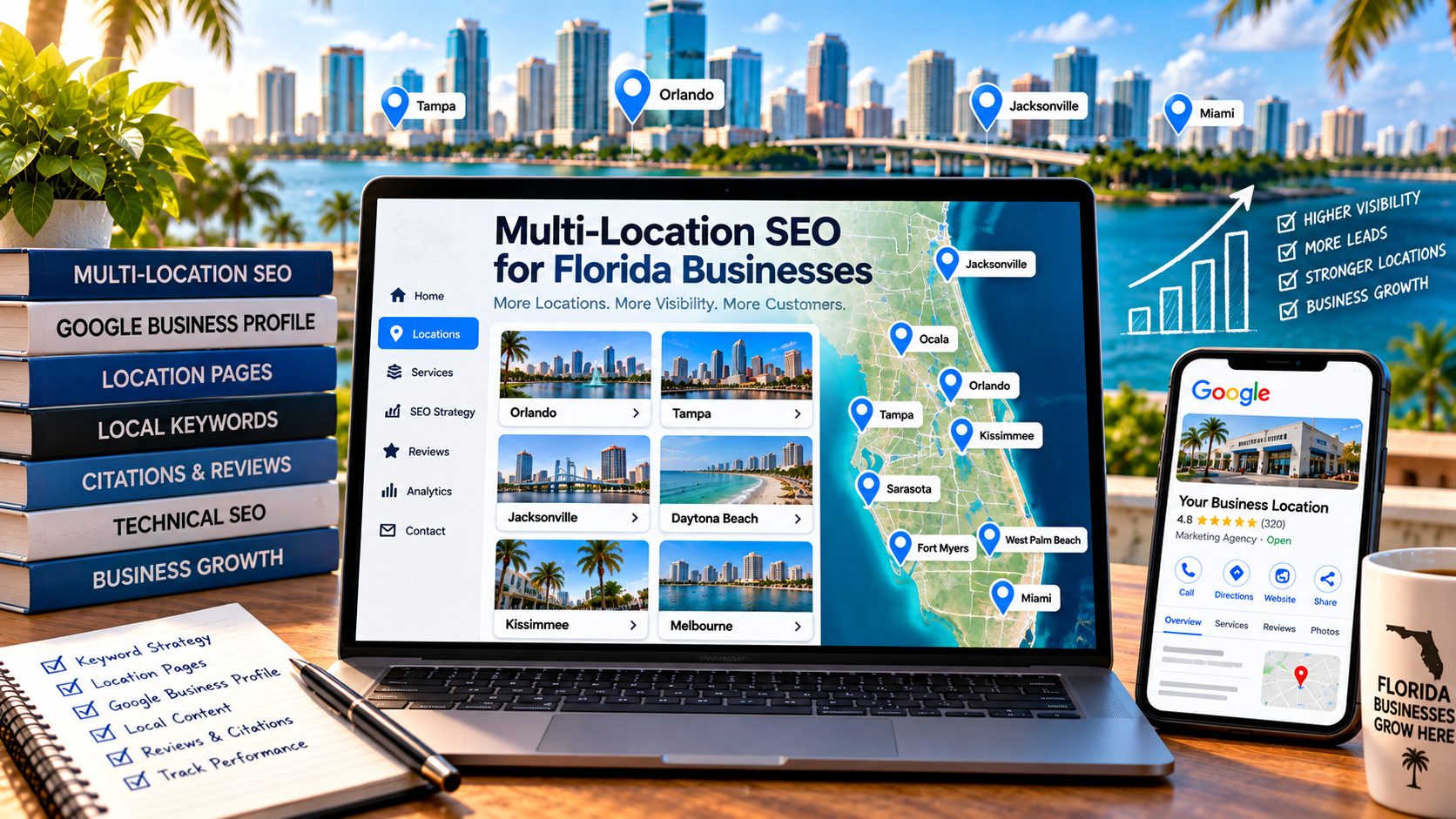
A successful multi-location SEO Florida strategy connects location-specific Google Business Profiles, dedicated location pages, localized content, internal linking, reviews, technical SEO, and accurate business information.
The goal is not to create hundreds of city pages. It is to build a scalable website structure where every genuine location has a clear purpose, useful information, and a strong connection to the services the business provides.
For businesses operating across Florida, this approach can help individual locations compete for relevant local searches while maintaining one strong overall website.
Why Multi-Location SEO Matters for Florida Businesses
Florida businesses often serve customers across multiple cities, counties, or regions.
A company may have locations in Orlando, Tampa, Jacksonville, Miami, Daytona Beach, Melbourne, Ocala, Clermont, or other Florida markets. Although these locations may operate under the same brand, customers search for them based on their specific geographic needs.
For example, someone may search for:
- SEO services near Orlando
- Web design in Tampa
- Roofing company in Daytona Beach
- Digital marketing agency in Ocala
- HVAC company near Melbourne
These searches have a strong local intent.
This is where a scalable local SEO strategy Florida businesses can use becomes important.
Instead of relying on one statewide page to target every market, businesses can create a logical structure connecting their main services with individual locations and supporting content.
The objective is:
One brand → multiple locations → clear local relevance → better user experience → stronger search visibility.
What Is Multi-Location SEO?
Multi-location SEO is the process of optimizing a business’s website and online presence for multiple physical locations or genuine service areas.
It can include:
- Google Business Profiles
- Location landing pages
- Service pages
- Local keyword research
- Customer reviews
- Business citations
- Internal linking
- Localized content
- Technical SEO
- Structured data
- Location-specific business information
The strategy should reflect the actual structure of the business.
A company with five offices may need a relatively simple setup. A larger organization with dozens of locations may require location directories, regional groupings, stronger internal linking, and more advanced technical management.
The important factor is not the number of pages. It is whether those pages provide a useful destination for the searches and customers they target.
1. Start With a Clear Location and Service Structure
Before creating location pages, determine how services and locations should connect.
A simple structure might look like:
Homepage
→ Services
→ SEO
→ Local SEO
→ Website Design
→ Google Ads
Locations
→ Orlando
→ Tampa
→ Kissimmee
→ Daytona Beach
→ Melbourne
→ Ocala
For a larger business, you may also need a service-and-location relationship such as:
Local SEO
→ Local SEO Orlando
→ Local SEO sanford
→ Local SEO Daytona Beach
The right structure depends on the business, but every important page should have a clear purpose.
Avoid creating pages simply because a city has search volume. First determine whether the business genuinely serves that market and whether there is enough useful information to justify a dedicated page.
2. Create Dedicated Location Pages
Dedicated location pages are one of the most important components of location pages SEO.
A strong location page should help a customer understand:
- Where the business operates
- What services are available
- Which customers it serves
- What areas are covered
- How to contact the business
- Why the location is relevant to them
A useful page can include:
Location Overview
Explain the company’s presence and service offering in that market.
Services Available
Highlight the products or services customers can actually receive.
Local Service Area
Mention nearby communities when they are genuinely part of the company’s coverage.
Contact Information
Provide accurate phone, address, hours, directions, or other relevant details.
Local FAQs
Answer questions customers in that market are likely to have.
Reviews or Local Proof
Include genuine customer feedback, projects, or other relevant evidence where available.
CTA
Give visitors a clear next step such as calling, requesting a quote, booking an appointment, or contacting the business.
For example, a statewide Florida SEO service can connect to dedicated location pages for individual markets such as Orlando, helping users find information relevant to their specific area.
3. Make Location Pages Useful Without Creating Unnecessary Pages
A multi-location website should avoid two extremes:
Too little local information:
Creating thin pages that provide almost no information beyond a city name.
Too many near-identical pages:
Publishing large numbers of pages where only the location name changes.
Instead, build pages around genuine business information.
Depending on the company, useful local elements may include:
- Services available at that location
- Local customer needs
- Service coverage
- Local projects
- Location-specific FAQs
- Reviews
- Team information
- Directions
- Contact details
If a location does not have enough useful information to justify its own page, consider whether it should simply be included within a broader service-area structure.
Quality and relevance should guide page creation.
4. Optimize Google Business Profiles for Each Location
For eligible physical locations, Google Business Profile is an important part of local search visibility.
Each genuine location should have accurate information that reflects the real-world business.
Important details can include:
- Business name
- Address
- Phone number
- Website
- Hours
- Business category
- Services
- Photos
- Reviews
The information on the website should also remain consistent with the relevant business profile and other important listings.
This becomes especially important when a company expands into new markets or changes locations, phone numbers, operating hours, or services.
A scalable Florida SEO strategy should include a process for keeping this information accurate over time.
5. Build a Keyword Strategy Around Service and Location Intent
Keyword research for a multi-location business should consider both what customers need and where they need it.
For example, a Florida digital marketing company might organize keywords around:
Service Keywords
- digital marketing agency
- SEO services
- local SEO
- website design
- Google Ads management
Location Keywords
- digital marketing agency Orlando
- SEO company Lakeland
- local SEO Daytona Beach
- website design Melbourne
Service + Location Keywords
- local SEO services Orlando
- website design company clermont
- Google Ads agency ocala
The objective is not to create a separate page for every variation.
Instead, group closely related keywords by search intent and decide which existing page should satisfy that search.
One well-structured page can often address multiple closely related queries naturally.
6. Build a Logical Internal Linking System
Internal linking becomes increasingly important as the number of locations grows.
Your website should clearly connect:
Statewide Service → Location → Supporting Content
For example:
Florida Local SEO Service Page
→ Orlando Location
→ Sanford Location
→ Kissimmee Location
A location page can also link to:
- Relevant service pages
- Main location directory
- Related locations
- Helpful blog articles
- Contact pages
For businesses targeting Central Florida markets, Boltz Media has dedicated pages for [Sanford local SEO services] and [Kissimmee local SEO services], which provide examples of connecting a broader local SEO offering with specific markets.
This structure helps users move between related pages while making the website hierarchy easier to understand.
7. Create Local Content That Supports Your Markets
Location pages should not be responsible for every SEO opportunity.
Supporting content can answer broader questions around local search, services, and customer needs.
For example:
- How local SEO works for Florida businesses
- How to improve Google Maps visibility
- How customers search for local services
- How to optimize a Google Business Profile
- How reviews influence customer decisions
- How businesses can structure location pages
A supporting article can then link naturally to the relevant service or location page.
This creates a useful relationship between informational content and commercial pages.
Boltz Media’s existing Local SEO guide for Florida small businesses can serve as a supporting resource within this content cluster.
The key principle is simple:
Create content because it helps the customer—not simply because another city keyword exists.
8. Build Local Authority Through Reviews and Citations
Reviews can provide valuable trust signals for local businesses.
A multi-location company should develop a consistent process for requesting genuine customer feedback.
Each location can build its own reputation based on the customers it serves.
Businesses should also maintain accurate information across relevant directories and industry listings.
Important details such as:
- Business name
- Address
- Phone number
- Website
- Hours
should be kept consistent wherever practical.
For multi-location businesses, this becomes an ongoing management task rather than a one-time SEO activity.
9. Use Location-Specific Technical SEO
Technical SEO becomes increasingly important as a website grows.
A multi-location website should have:
- Crawlable location pages
- Logical URLs
- Clear headings
- Unique title tags
- Useful meta descriptions
- Internal links
- Mobile-friendly pages
- Fast-loading templates
- Appropriate canonicalization
- XML sitemap coverage
- Accurate structured data where applicable
The technical setup should reflect the real business structure.
Do not use structured data to create a location or business relationship that does not actually exist.
10. Create a Scalable URL Structure
A consistent URL structure makes a growing website easier to manage.
For example:
/locations/orlando/
or:
/orlando/
For a service-specific location structure, a business might use:
/services/local-seo/orlando/
The best option depends on the website’s overall architecture.
What matters most is that URLs are:
- Simple
- Consistent
- Descriptive
- Scalable
- Easy to understand
Once a location page begins earning visibility and links, avoid changing its URL unnecessarily.
11. Connect Location Pages With the Main Florida SEO Strategy
Your statewide and location pages should have different purposes.
For example:
Florida Local SEO Page
Targets broader statewide intent and explains the overall service.
Orlando Location Page
Targets customers specifically searching for that service in Orlando.
Supporting Blog
Answers a broader educational question related to local search.
This creates a logical content hierarchy:
Statewide Service → Location → Supporting Content
It also reduces unnecessary competition between pages targeting similar search intent.
12. Measure Performance by Location
A multi-location strategy should be measured beyond total website traffic.
Where possible, monitor performance for individual markets.
Useful metrics include:
- Organic clicks
- Search impressions
- Local keyword visibility
- Google Maps visibility
- Phone calls
- Form submissions
- Appointment requests
- Direction requests
- Reviews
- Conversion rate
- Qualified leads
One location may generate more traffic while another produces more qualified leads.
The goal is to understand which markets are creating meaningful business opportunities—not simply which pages receive the most visits.
Common Multi-Location SEO Mistakes
Creating Thin Location Pages
A page with little useful information provides limited value to customers.
Copying the Same Page Across Cities
Changing only the city name does not create meaningful local relevance.
Creating Locations You Do Not Actually Serve
Location targeting should reflect genuine business coverage.
Ignoring Google Business Profiles
Website optimization is only one part of a local search strategy.
Overusing City Keywords
Repeatedly inserting city names can make content unnatural and reduce readability.
Creating Too Many Pages
More pages do not automatically produce more visibility. Build pages where there is genuine business and search value.
Forgetting Internal Links
Location pages should connect to relevant services, directories, blogs, and other useful resources.
Measuring Only Rankings
Rankings matter, but calls, inquiries, conversions, and qualified leads are more closely connected to business outcomes.
What Should a Florida Multi-Location SEO Strategy Include?
A practical strategy can be organized into five stages.
Stage 1: Research
Identify:
- Locations
- Services
- Search intent
- Competitors
- Existing rankings
- Google Business Profiles
- Current website structure
Stage 2: Architecture
Create:
- Service hierarchy
- Location directory
- Location pages
- Internal linking structure
- URL structure
Stage 3: Optimization
Improve:
- Titles
- Headings
- Content
- Internal links
- Images
- Technical SEO
- Business information
- Conversion elements
Stage 4: Local Authority
Develop:
- Genuine reviews
- Accurate citations
- Local mentions
- Relevant backlinks
- Useful local content
Stage 5: Measurement
Monitor:
- Rankings
- Organic traffic
- Maps visibility
- Leads
- Calls
- Conversions
- Location-level performance
This creates a repeatable framework that can expand as the business enters additional Florida markets.
How Many Location Pages Should a Florida Business Create?
There is no universal number.
A business should create location pages for markets where it genuinely operates or provides services and where a dedicated page can offer useful information.
A company with six Florida locations may need six strong pages. A larger organization may require a much broader architecture.
The decision should consider:
- Actual locations
- Service coverage
- Customer demand
- Business priorities
- Search intent
- Available local information
- Ability to maintain the pages
The objective is to build a useful website structure, not to maximize the page count.
When Should a Business Invest in Multi-Location SEO?
Multi-location SEO can be particularly useful when a business:
- Has multiple physical locations
- Serves several Florida markets
- Has separate offices or teams
- Wants location-level lead generation
- Has established demand across multiple cities
- Is expanding into new Florida markets
- Already has local visibility but wants to scale
It can also support service-area businesses when their online location strategy accurately represents the areas they genuinely serve.
Build a Scalable Florida SEO Strategy With Boltz Media
A multi-location website needs more than city-specific keywords.
It needs a clear relationship between:
Services + Locations + Content + Technical SEO + Local Search + Conversions
Boltz Media helps Florida businesses build local search strategies around these elements, including website structure, location-focused content, local SEO, and search visibility.
Businesses can explore [Florida local SEO services] to learn more about building a strategy around multiple markets.
The goal is not to create the largest number of location pages.
The goal is to create the right pages, for the right markets, with the right information.
Frequently Asked Questions About Multi-Location SEO Florida
What is multi-location SEO?
Multi-location SEO is the process of optimizing a business website and local search presence for multiple physical locations or genuine service areas. It can include location pages, Google Business Profiles, local keywords, reviews, citations, internal linking, and technical SEO.
How does multi-location SEO work in Florida?
A Florida multi-location strategy connects statewide service pages with individual location pages and supporting content. Each location should have accurate business information and useful information relevant to its market.
Are location pages good for SEO?
Location pages can support local search visibility when they represent genuine markets and provide useful information. Pages created only by changing city names provide much less value.
Should every Florida city have its own SEO page?
Not necessarily. Businesses should create pages for locations they genuinely serve and where there is enough useful information to justify a dedicated page.
How do I avoid duplicate content across location pages?
Build each page around the actual services, customers, coverage, contact details, reviews, FAQs, and other information relevant to that market instead of copying one generic template with a different city name.
What keywords should multi-location businesses target?
Keyword research should combine service intent with geographic intent. For example, a business may target broader Florida SEO terms while developing individual pages for important city and service combinations.
How important are Google Business Profiles for multiple locations?
Google Business Profiles are an important part of local search visibility for eligible locations. Accurate information, appropriate categories, services, photos, and genuine reviews can support each location’s local presence.
Can one SEO strategy work for every Florida location?
The overall framework can be standardized, but individual locations should reflect their actual services, markets, competition, and customer needs.
Final Takeaway
Building a successful multi-location SEO Florida strategy is not about creating as many city pages as possible.
It is about building a website and local search presence that clearly connects:
Business → Service → Location → Relevant Content → Local Search Visibility → Customer Action
For Florida businesses operating across multiple markets, a structured local SEO strategy Florida framework can make location management more scalable while giving customers more relevant information.
Start with the locations you genuinely serve. Build useful pages for those markets. Connect them through a logical website structure. Keep business information accurate. Build genuine local authority. Then measure which locations are generating meaningful visibility and business results.
That creates a more sustainable approach to Florida SEO—one that can scale with the business without sacrificing content quality or user experience.