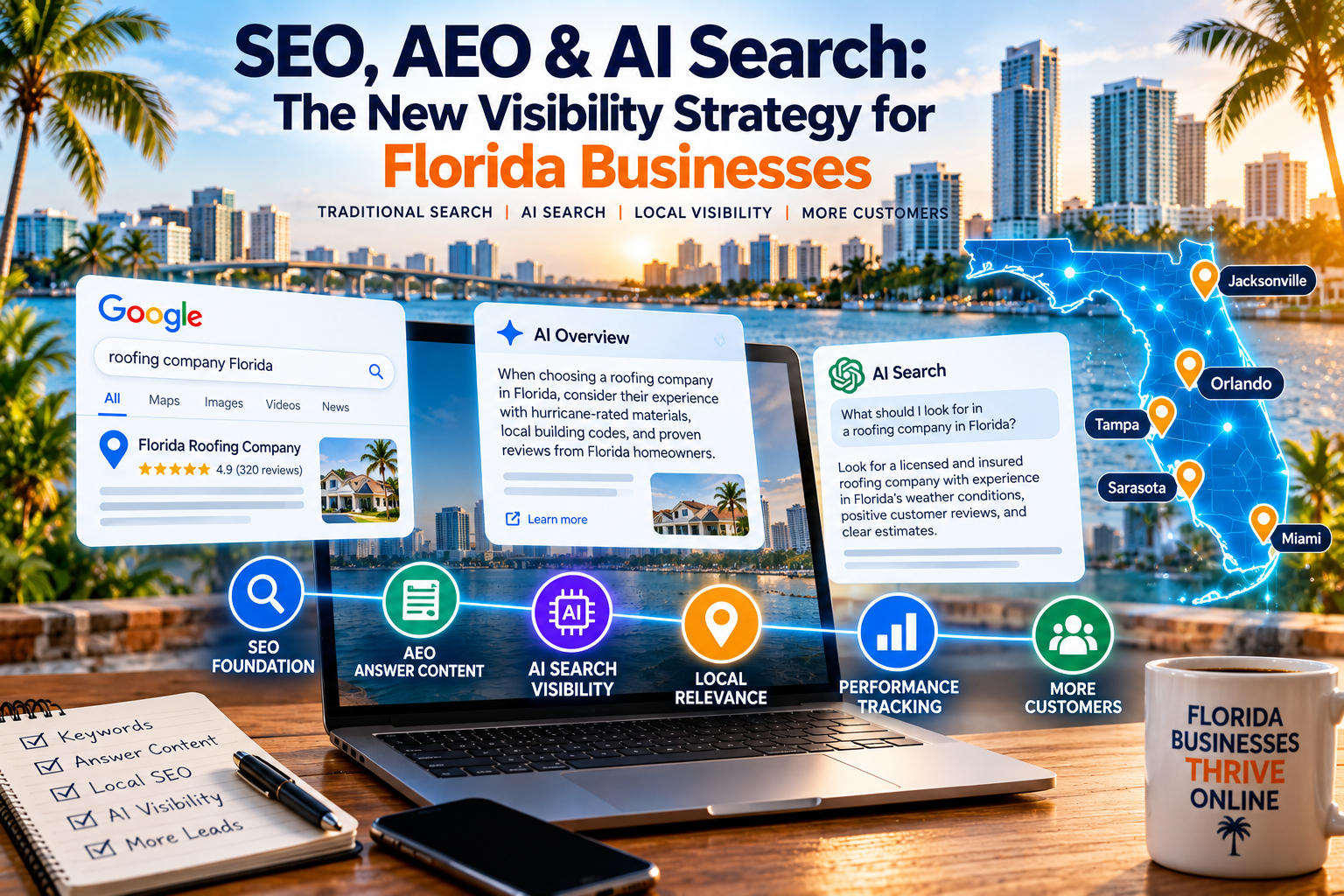
Search visibility is expanding beyond traditional Google rankings. Florida businesses now need to consider conventional search, local search, AI Overviews, AI Mode, conversational search, and other AI-powered discovery experiences.
That does not mean traditional SEO is being replaced. Google states that its existing SEO best practices remain relevant to AI features such as AI Overviews and AI Mode, with no additional technical requirements or special optimization needed to appear in those experiences.
A practical SEO AEO Florida strategy therefore combines strong technical SEO, clear website architecture, useful answers, accurate business information, local relevance, original expertise, and measurable conversion paths.
The objective is not to optimize separately for every AI platform. It is to build a digital presence that search engines, AI systems, and customers can understand and trust.
What Is SEO AEO Florida?
SEO AEO Florida describes a combined approach to Search Engine Optimization and Answer Engine Optimization for businesses targeting customers throughout Florida.
Traditional SEO focuses on helping search engines crawl, understand, index, and rank webpages.
AEO focuses more heavily on answering questions clearly and structuring information so it can be easily understood in answer-based search experiences.
Consider two searches:
“roofing company Florida”
and:
“What should I look for when choosing a roofing company in Florida?”
The first has strong commercial intent. The second requires explanation and context.
A modern website should be capable of serving both types of search intent.
Google’s documentation also notes that terms such as AEO and generative engine optimization, or GEO, are used in the industry to describe efforts around AI search, while emphasizing that foundational SEO remains important.
Why AI Search Is Changing Business Visibility
Search is becoming increasingly conversational.
Instead of entering several short searches, users can ask longer questions, add context, compare options, and continue with follow-up questions.
Google describes AI Overviews as a way to help users understand complex topics more quickly, while AI Mode is designed for more exploratory and nuanced searches. These experiences can also surface links to supporting websites.
For a Florida business, this creates more than one path to discovery.
A potential customer might find a company through:
- Traditional Google results
- Google Maps
- Local search
- AI Overviews
- AI Mode
- Conversational search
- Business directories
- Reviews
- Industry websites
- Social platforms
The important change is that visibility increasingly depends on being a useful source of information, not simply occupying a position for one keyword.
1. Start With Strong SEO Foundations
The foundation of an SEO AEO Florida strategy is still traditional SEO.
Before thinking about AI visibility, make sure search engines can access and understand the website.
Important foundations include:
- Crawlable pages
- Proper indexing
- Logical site architecture
- Descriptive titles and headings
- Mobile usability
- Fast and functional pages
- Internal linking
- Relevant content
- Clear navigation
- Accurate structured data
- Important information available as text
Google specifically recommends applying the same foundational SEO practices to AI search features that businesses already use for Google Search. There are no additional technical requirements for appearing as a supporting link in AI Overviews or AI Mode.
So the first question should not be:
“How do I rank in AI?”
It should be:
“Is my website technically strong enough for search engines to access and understand?”
2. Create Content Around Search Intent and Questions
Keyword targeting remains useful, but modern search strategy should go beyond individual phrases.
A Florida plumbing company, for example, may target:
Primary service:
Emergency Plumbing
Then build supporting information around real customer questions:
- What should I do when a pipe bursts?
- How quickly should an emergency plumber respond?
- What causes low water pressure?
- When should a water heater be replaced?
- How much does emergency plumbing typically involve?
These questions represent different stages of the customer journey.
A person searching for an emergency plumber may be ready to call immediately. Someone researching water pressure may still be trying to understand the problem.
Addressing both types of intent gives the website a broader role in the buying journey.
3. Make Business and Local Information Clear
For local businesses, search visibility depends partly on whether search systems can clearly understand who the business is, what it offers, and where it operates.
A Florida business website should make information such as the following easy to find:
- Business name
- Services
- Service areas
- Physical location where applicable
- Contact information
- Business hours
- Industries served
- Experience
- Credentials
- Relevant qualifications
This is especially important for service-area businesses.
A company should define its actual market rather than treating the entire state as its service area simply because it wants statewide visibility.
For example, if a residential roofing company regularly serves several counties but does not travel throughout Florida, its website should communicate that actual coverage.
Google also recommends keeping Business Profile information up to date as part of its guidance for AI search visibility.
4. Make Answers Easy to Find
Answer-focused content does not require complicated formatting.
The main goal is clarity.
Important information can be organized through:
- Descriptive headings
- Short paragraphs
- Lists
- Comparison tables
- FAQs
- Definitions
- Step-by-step explanations
- Supporting examples
For example, instead of burying an answer about roof maintenance inside a 1,500-word paragraph, a page could include a heading:
How Often Should a Florida Roof Be Inspected?
Then provide a direct explanation followed by relevant factors.
This structure makes the page easier for people to scan and easier for search systems to interpret.
5. Build Genuine Florida Relevance
A statewide Florida strategy should not simply replace another state’s name with “Florida.”
Useful local relevance comes from understanding the market.
Consider a Florida roofing company.
Its content could discuss how roofing decisions may be affected by:
- Heavy rainfall
- Strong storms
- High humidity
- Intense sun exposure
- Wind conditions
- Coastal environmental factors
- Maintenance requirements
The business should explain these considerations accurately rather than inserting Florida references into every paragraph.
The same principle applies to other industries.
A pest-control company might discuss Florida-specific pest conditions. An HVAC company can address the importance of cooling-system performance in a hot climate. A property-management company may address the needs of Florida rental properties.
The location should add information—not just keywords.
6. Build Topical Coverage Around Important Services
Topical authority is easier to build when related content has a clear relationship to the company’s services.
Suppose a Florida pest-control company specializes in termites.
Its website could have:
Core Service:
Termite Control
Supporting Topics:
- Signs of Termite Activity
- How Termite Inspections Work
- Subterranean vs. Drywood Termites
- Termite Prevention
- When Professional Treatment Is Necessary
- Questions to Ask Before Hiring a Termite Company
The purpose is to cover the subject comprehensively enough that customers can understand the problem and the available solution.
Each supporting page can then connect naturally to the relevant service.
This creates a logical relationship between informational content and commercial pages without requiring every article to target another keyword variation.
7. Understand AI Search Florida as a New Discovery Environment
The term AI search Florida describes the growing use of AI-powered search experiences to research businesses, services, products, and questions related to Florida.
Imagine someone asks:
“What should I consider before hiring a commercial roofing company in Florida?”
An AI-powered search experience may provide a synthesized response and links to supporting sources.
A roofing company therefore has an opportunity to publish genuinely useful information about:
- Roofing-system considerations
- Maintenance
- Inspections
- Weather exposure
- Commercial property requirements
- Contractor qualifications
- Project planning
The objective is not to predict the exact wording an AI system will use.
It is to make the company’s website a useful source for the questions its customers actually ask.
8. Use Original Expertise to Differentiate Your Website
AI systems can generate generic explanations quickly.
That makes original business knowledge more valuable.
A company can add differentiation through:
- First-hand experience
- Original case studies
- Project examples
- Expert commentary
- Proprietary data
- Industry observations
- Customer questions
- Before-and-after examples
- Detailed processes
For example, a Florida contractor could explain common mistakes it sees during home improvement projects and how customers can avoid them.
A healthcare practice could explain common patient questions about a particular service.
A digital marketing agency could publish anonymized campaign lessons or explain how it evaluates lead quality.
The information becomes more useful because it comes from actual experience rather than generic summaries.
9. Strengthen Trust Across the Web
Search visibility is only part of the customer decision.
Customers also need reasons to trust the business.
Useful trust signals can include:
- Genuine reviews
- Testimonials
- Case studies
- Certifications
- Licenses where applicable
- Industry memberships
- Media mentions
- Professional profiles
- Original project examples
Consistency also matters.
The business name, services, contact information, and other important details should be accurate across relevant platforms.
The goal is not to manufacture mentions.
It is to make the business’s real reputation easier to verify.
10. Use AI SEO as a Workflow, Not a Content Factory
AI SEO can help marketers work more efficiently.
AI tools can assist with:
- Keyword clustering
- Search-intent research
- Content outlines
- Question discovery
- Content-gap analysis
- Data analysis
- Internal-link planning
- Draft organization
But the tool should support the strategy rather than become the strategy.
For example, an AI tool can identify questions about Florida roofing, but a roofing professional should still determine which questions matter most and provide accurate industry-specific information.
This approach helps maintain efficiency without turning the website into a collection of generic AI-generated pages.
Google’s guidance allows generative AI to assist with content creation, while emphasizing the importance of content that provides value to users rather than producing large quantities of pages without meaningful value.
11. Connect SEO, AEO and Conversion Strategy
Visibility alone does not generate revenue.
A visitor who discovers a business through search still needs a clear path to becoming a lead or customer.
Important conversion elements can include:
- Clear calls to action
- Service-specific landing pages
- Click-to-call buttons
- Quote forms
- Booking options
- Trust signals
- Service information
- FAQs
- Contact information
For example:
Search:
“commercial electrician Florida”
Landing page:
Commercial Electrical Services
Conversion path:
Request an Estimate
SEO brings the visitor to the website.
AEO-style content helps answer questions.
Conversion design gives the visitor a next step.
These functions should work together rather than being treated as separate campaigns.
12. Strengthen Internal Linking
Internal links help users move between related information and help search engines understand how pages relate to one another.
A simple structure might look like:
Service Page → Supporting Article → Related Service → Relevant Location Page
For example:
AC Repair → Why an AC Runs but Doesn’t Cool → AC Maintenance → Relevant Service Area
Internal links should be contextual.
There is no need to link every keyword to another page. The goal is to guide users to the next useful resource.
13. Use Structured Data Accurately
Structured data can help Google understand certain types of information on a page.
Depending on the website, relevant structured data may include:
- Organization
- Local business
- Article
- Product
- Service
- Breadcrumb
- Event
However, structured data should accurately represent the visible content.
Google’s AI search documentation specifically recommends making sure structured data matches visible text and notes that there is no special AI schema required for AI Overviews or AI Mode.
Therefore, structured data should support an already well-structured website rather than become an attempt to manufacture AI visibility.
14. Avoid Unsupported AI Optimization Tactics
As AI search becomes more important, businesses will encounter claims about special techniques that supposedly guarantee AI visibility.
Be careful with these promises.
Google’s current documentation states that websites do not need special AI text files, new machine-readable files, or special schema to appear in AI Overviews or AI Mode. The same documentation points businesses back toward fundamental SEO practices.
That means businesses should be cautious about tactics such as:
- Creating pages solely for AI systems
- Adding unnecessary AI-related keywords
- Producing thousands of automatically generated pages
- Adding unsupported markup
- Creating artificial entity associations
- Claiming guaranteed AI citations
- Rewriting every page simply because AI search exists
The better approach is to improve the website itself.
15. Measure AI Search Visibility in Search Console
AI visibility should not remain theoretical.
Google introduced dedicated Search Generative AI performance reports in Search Console on June 3, 2026. Google said the reports provide visibility into impressions from generative AI features such as AI Overviews and AI Mode, along with information about the pages appearing in those features. Google subsequently stated that the insights were rolled out to all websites worldwide by August 31, 2026.
For a Florida business, this makes Search Console a practical part of the measurement process.
Check your verified property in Search Console and look for the available generative AI performance insights. Review:
- Which pages receive generative AI impressions
- How impressions change over time
- Which content is appearing
- Which queries or topics are associated with visibility where available
- Whether visibility is translating into website engagement and leads
Do not evaluate the strategy using AI impressions alone.
Connect Search Console data with analytics, calls, forms, bookings, and other business outcomes.
16. Define Your Actual Florida Market
A statewide target does not mean every business should claim every Florida market.
A service company should first determine which geographic model matches its operations.
For example:
Regional Service Business
A contractor may genuinely serve a defined group of counties.
Its website should clearly explain that coverage.
Multi-Market Service Business
A company may have teams that regularly operate across several distinct Florida markets.
Its website can organize service information around those genuine markets.
Statewide Business
Some companies genuinely serve customers throughout Florida.
They may require a broader statewide content and acquisition strategy.
The key is to align the website with actual operations.
A business should not create location pages simply because a keyword tool shows search volume for a city it does not meaningfully serve.
How SEO, AEO and AI Search Work Together
These concepts have different roles.
SEO
Builds the technical and content foundation for search visibility.
AEO
Encourages clear answers to the questions customers ask.
AI Search
Creates additional discovery environments where search systems can synthesize information and surface supporting sources.
A strong strategy connects all three.
The website should be technically accessible, logically organized, locally relevant, informative, and easy for customers to act on.
What Florida Businesses Should Do First
Businesses do not need to rebuild everything at once.
A practical sequence is:
Step 1: Audit Technical SEO
Check crawling, indexing, site architecture, mobile usability, internal links, and page performance.
Step 2: Review Existing Content
Identify important services that lack strong pages and customer questions that remain unanswered.
Step 3: Strengthen Florida Relevance
Add useful local information where it genuinely improves the customer’s understanding.
Step 4: Improve Trust
Document real experience, credentials, reviews, projects, and expertise.
Step 5: Connect Content to Services
Make sure informational pages provide logical pathways toward relevant commercial pages.
Step 6: Measure
Use Search Console, analytics, call tracking, forms, and CRM data to understand whether visibility produces business results.
Common SEO, AEO & AI Search Mistakes
Keyword Stuffing
Repeating phrases such as “SEO AEO Florida” excessively can make content unnatural.
Generic AI Content
Producing large quantities of similar articles does not automatically create authority.
Fake Location Targeting
Creating pages for markets the business does not genuinely serve can weaken trust and usefulness.
Ignoring Technical SEO
AI search does not remove the need for crawlable, indexable websites.
Chasing Guaranteed AI Rankings
No legitimate strategy can guarantee that a particular page will be selected for an AI-generated response.
Measuring Only Rankings
Search visibility should ultimately connect to qualified traffic, leads, customers, and revenue.
The Future of Search for Florida Businesses
Search is moving toward more conversational, contextual, and multimodal experiences.
Google’s current AI search documentation describes AI Overviews and AI Mode as experiences that can help users explore complex questions while providing links to supporting websites.
For businesses, the practical response is not to abandon traditional SEO.
It is to broaden the definition of search visibility.
A strong website should be able to:
- Rank for relevant searches
- Answer customer questions
- Communicate local relevance
- Demonstrate expertise
- Provide accurate business information
- Support multiple search intents
- Convert visitors into inquiries
That foundation can remain useful even as individual search interfaces change.
Build a Modern SEO AEO Florida Strategy
The modern search landscape requires more than targeting a list of keywords.
Florida businesses need a website that communicates what they do, where they operate, why customers should trust them, and how their expertise solves real problems.
Traditional SEO provides the technical and structural foundation.
AEO encourages clearer answers.
AI search creates another environment where useful information can be discovered.
Generative engine optimization and AI SEO can be considered within that broader strategy, but they should not replace the fundamentals.
For businesses looking to strengthen their local search foundation, Local SEO services in Florida can support geographic visibility, while Digital Marketing services in Florida can connect search with broader customer acquisition.
Frequently Asked Questions
What is SEO AEO Florida?
SEO AEO Florida is a combined approach to SEO and answer-focused search optimization for businesses targeting customers across Florida. It connects traditional search fundamentals with content designed to answer customer questions clearly.
Is SEO still important with AI search?
Yes. Google states that foundational SEO best practices remain relevant to AI features such as AI Overviews and AI Mode. There are no additional technical requirements specifically for appearing in these features.
What is AI search Florida?
AI search Florida refers to AI-powered and conversational search experiences used to discover information about Florida businesses, services, products, and topics.
What is generative engine optimization?
Generative engine optimization, or GEO, is an industry term used for efforts aimed at improving visibility within generative AI search experiences. Google notes that terms such as AEO and GEO are used in the industry while emphasizing foundational SEO practices.
What is AI SEO?
AI SEO generally refers to adapting SEO workflows and content strategies for search environments that increasingly use artificial intelligence. It can include search-intent analysis, content organization, question research, and evaluation of AI-powered search visibility.
Can a business guarantee AI search visibility?
No. Following SEO best practices does not guarantee that Google or another AI system will select, display, or cite a particular webpage.
Should Florida businesses create pages for every city?
No. Location pages should correspond to genuine service coverage or legitimate business operations and should provide useful information rather than simply repeating city names.
How can I monitor AI search visibility?
Verified website owners should check Search Console for the available generative AI performance insights. Google says these reports provide information about visibility in generative AI features such as AI Overviews and AI Mode, and the reporting was rolled out globally by August 31, 2026.
Final Takeaway
SEO, AEO, and AI search are becoming interconnected parts of modern online visibility.
For Florida businesses, the most sustainable approach is to strengthen the fundamentals first: build a technically sound website, publish original and useful information, communicate genuine Florida relevance, maintain accurate business details, answer customer questions clearly, and connect search visibility to measurable business outcomes.
The goal is not to chase every new AI optimization tactic.
It is to build a digital presence that remains useful to customers and understandable to search systems-whether someone discovers the business through a traditional result, local search, an AI-generated answer, or a conversational search experience.