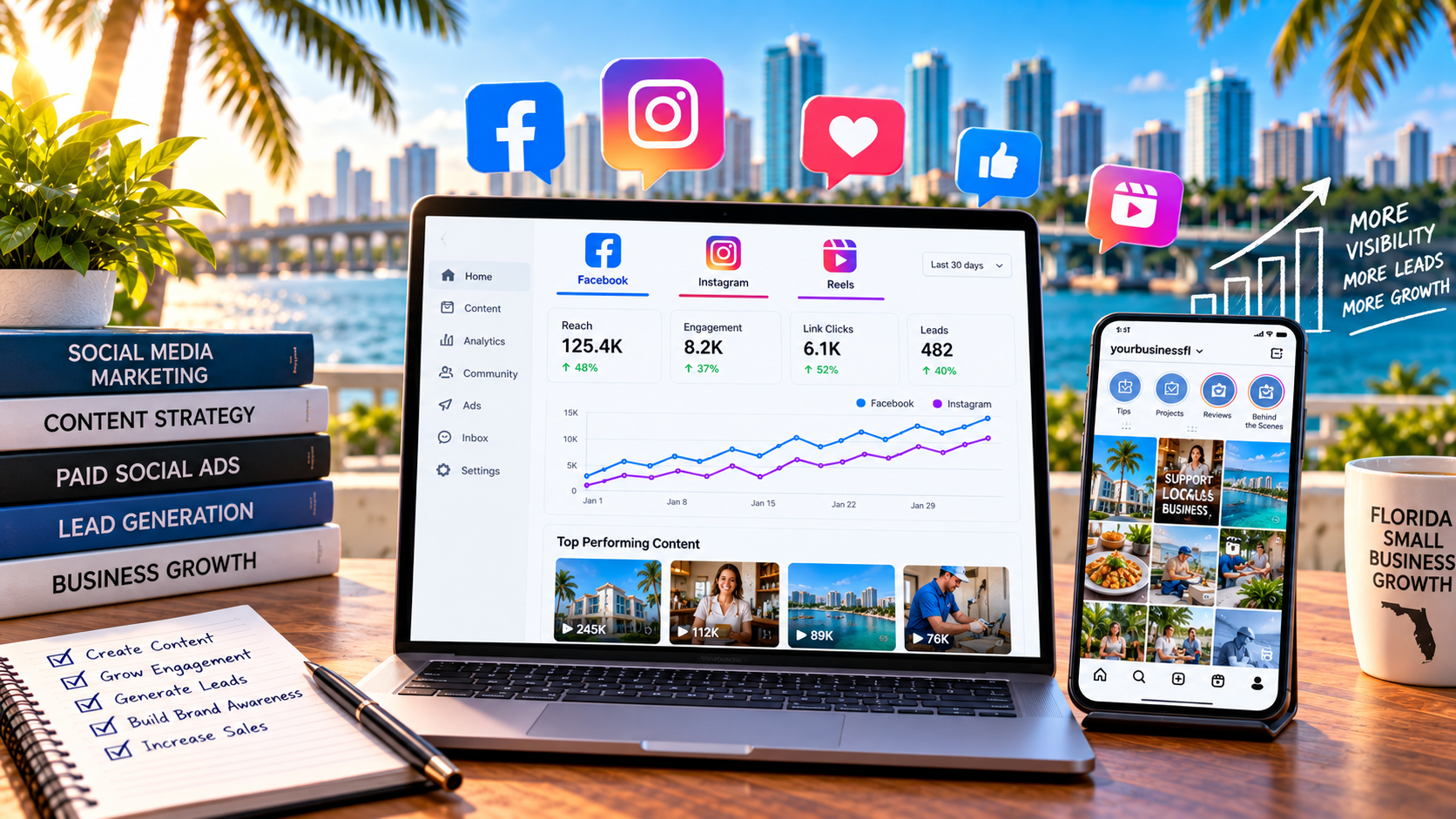
Social media remains an important marketing channel for Florida small businesses, but simply maintaining an active Facebook or Instagram account is no longer enough.
In 2026, businesses need to think beyond posting frequency. Effective social media marketing is about creating content that gives people a reason to stop, watch, learn, interact, visit a website, send a message, or eventually become a customer.
For businesses across Florida, this means combining original content, short-form video, platform-specific strategies, customer communication, paid advertising, and performance analysis.
The right approach depends on the business, audience, industry, and marketing objective. A company trying to generate service inquiries will need a different social strategy from an e-commerce brand focused on product sales.
This guide explains what works for social media marketing Florida businesses in 2026, how Facebook and Instagram can be used, what types of content are worth creating, how AI is changing social media management, and what businesses should consider when choosing professional support.
What Is Social Media Marketing for Florida Businesses?
Social media marketing is the use of platforms such as Facebook and Instagram to promote a business, communicate with customers, distribute content, build awareness, and support business objectives.
For a Florida small business, social platforms can be used to:
- Introduce the brand to potential customers
- Showcase products and services
- Generate website traffic
- Encourage inquiries and messages
- Demonstrate expertise
- Showcase completed work
- Share customer experiences
- Promote offers and events
- Build relationships with existing customers
- Support paid advertising campaigns
The important part is connecting social activity with a specific purpose.
A service business may use social media to generate phone calls and quote requests. A manufacturer may use it to demonstrate production capabilities and build relationships with buyers. A restaurant may focus on visual content and customer experiences.
There is no single formula that fits every business.
What Actually Works in 2026?
Several developments are particularly relevant to small businesses this year.
Original Business Content
One of the clearest changes is the growing importance of original content.
Meta said in March 2026 that Facebook is prioritizing original content in Feed and Reels while reducing the distribution of unoriginal or duplicative content. Meta also clarified that content created directly by the owner or creator of a Page or Profile qualifies as original content.
For businesses, this creates a practical opportunity.
Instead of relying heavily on generic stock images, recycled videos, or copied trends, businesses can create content around their own:
- Products
- Services
- Employees
- Projects
- Processes
- Equipment
- Expertise
- Customer questions
- Business experience
For example, a Florida service company can show how a service is performed. A manufacturer can demonstrate part of its production process. A professional firm can answer a question customers frequently ask.
The content becomes more distinctive because it comes directly from the business.
Short-Form Video
Short-form video remains an important format across Facebook and Instagram.
Meta reported in January 2026 that Facebook was surfacing more same-day Reels and that original content represented 75% of Instagram recommendations in the U.S. in Q4 2025.
For small businesses, this does not mean every Reel needs professional production.
Useful short-form videos can include:
- Quick tips
- Frequently asked questions
- Before-and-after projects
- Product demonstrations
- Service explanations
- Behind-the-scenes footage
- Customer problems and solutions
- Team introductions
- Industry insights
- Common mistakes
A simple framework is:
One video → One useful idea → One clear takeaway.
Using Facebook to Reach Local Customers
Facebook can support several objectives, including local awareness, community engagement, customer communication, content distribution, and paid advertising.
It can be particularly useful for businesses that want to maintain an active community presence while providing practical information.
Content can include:
- Business updates
- Educational posts
- Customer questions
- Project photos
- Testimonials
- Offers
- Events
- Videos
- Product information
- Community involvement
Facebook should not be treated only as a digital notice board.
A business can use its Page to answer questions, respond to customers, share useful information, and direct people toward relevant services.
Original content is particularly important here. Meta says it is actively working to reward original creators on Facebook and deprioritize duplicative or low-value reposted content.
For businesses targeting Florida audiences, this makes authentic business-generated content a practical part of the strategy.
Instagram Marketing for Florida Businesses
Instagram can be especially effective when a company has products, projects, people, processes, or expertise that can be communicated visually.
Content can include:
- Reels
- Carousels
- Product photography
- Project showcases
- Stories
- Educational content
- Customer experiences
- Behind-the-scenes content
Industries with naturally visual material can benefit from showing their work directly.
However, Instagram is not limited to visually driven industries.
A professional service business can turn common customer questions into short educational videos.
A manufacturer can explain how a product is made.
A consultant can share practical advice.
A B2B company can explain technical concepts in simple language.
The goal is to make the expertise understandable and useful.
This is where Instagram marketing Florida businesses invest in can become more than simply posting attractive images. The platform can become a way to demonstrate expertise and show potential customers what the business actually does.
Why Reels Matter for Small Businesses
Reels can help businesses communicate information quickly without requiring a customer to read a long caption first.
Consider the difference between these two approaches:
Static post:
“Our company provides professional services for Florida businesses.”
Reel:
“Three things to check before hiring a digital marketing agency.”
The second gives the viewer a specific reason to watch.
Other Reel concepts include:
Educational:
“Three mistakes customers make before starting this project.”
Process:
“Here is what happens after you book our service.”
Demonstration:
“Watch how this product works.”
Before and after:
“See the difference before and after the project.”
FAQ:
“How long does the process normally take?”
Behind the scenes:
“A look inside our daily operations.”
This type of content can also be reused across other parts of the marketing strategy.
A useful Reel can become a Facebook post, website article, email topic, or advertising creative.
What Types of Content Work Best?
There is no single content type that should dominate every business account.
A stronger strategy uses several content categories.
Educational Content
Answer questions that potential customers already have.
Examples include:
- How-to information
- Industry tips
- Maintenance advice
- Common mistakes
- FAQs
- Comparisons
- Buying considerations
Educational content gives people a reason to follow the account even when they are not immediately ready to buy.
Service and Product Content
Explain what the business actually provides.
Instead of simply saying:
“We provide professional services.”
show:
- What the service includes
- Who needs it
- What problem it solves
- How the process works
- What customers should expect
This makes promotional content more informative.
Behind-the-Scenes Content
Show the people and processes behind the business.
This could include:
- Team members
- Equipment
- Production
- Installations
- Packaging
- Workspaces
- Daily operations
For many small businesses, this type of content is easier to produce than highly designed promotional graphics.
Customer Proof
Businesses can showcase legitimate evidence of their work through:
- Completed projects
- Testimonials
- Reviews
- Case studies
- Before-and-after examples
- Certifications
- Product applications
Proof is particularly useful when customers need confidence before making a purchase or inquiry.
Business Expertise
Turn the knowledge inside the company into content.
A business owner, salesperson, technician, engineer, designer, or manager may already have dozens of useful topics they discuss with customers.
Those conversations can become social content.
How Often Should a Florida Business Post?
There is no universal number of posts that guarantees success.
The better approach is to create a schedule the business can maintain without sacrificing quality.
For example, a small business might use:
- 2 Reels per week
- 2 educational or visual posts per week
- Stories throughout the week
Another business may need a different schedule.
The important consideration is whether the business can consistently create worthwhile content.
Posting more does not automatically make a strategy better.
A smaller number of useful posts can be more valuable than a large volume of repetitive content.
Should Every Post Promote a Product or Service?
No.
A social media account that constantly says “Buy now,” “Contact us,” or “Get a quote” can become repetitive.
A more balanced approach can include:
Educate → Demonstrate → Build Trust → Engage → Promote
For example:
- Educational Reel
- Behind-the-scenes post
- Customer result
- FAQ carousel
- Service explanation
- Product demonstration
- Promotional offer
Promotional content still matters, but it works better when the audience already understands the business and finds the account useful.
How Local Relevance Fits Into a Florida Strategy
A statewide strategy does not mean every post needs a city name.
For most businesses, the better approach is to establish the company as a Florida brand while using location only when it genuinely adds context.
For example, content can reference:
- Florida-specific customer concerns
- Local weather or seasonal considerations
- Regional service requirements
- Florida industry trends
- Local projects
- Community activities
- Customer questions from the service area
This creates local relevance without forcing location keywords into every caption.
For businesses that serve multiple Florida markets, location-specific content can be created when there is a genuine reason to discuss that market.
The focus should remain on useful content first and location second.
How Social Media and Local SEO Can Work Together
Social media and SEO are different marketing channels, but they can support the same customer journey.
For example:
Social Media:
Creates awareness and engagement.
Website:
Provides detailed information.
Local SEO:
Helps potential customers discover relevant services through search.
Google Business Profile:
Supports local discovery and customer actions.
Paid Advertising:
Expands targeted reach.
A single useful topic can therefore be turned into multiple marketing assets.
For example, a Florida HVAC company could create:
- A Reel explaining common AC problems
- A Facebook post expanding on the topic
- A blog explaining the issue in detail
- A service page explaining the company’s solution
- A paid campaign promoting the service
Businesses looking to strengthen their local search visibility can also explore Local SEO services in Florida.
Should Florida Small Businesses Use Social Media Advertising?
Organic social media and paid advertising can work together, but they serve different purposes.
Organic content helps a business maintain its presence, educate its audience, demonstrate expertise, and build familiarity.
Paid advertising can be used when the business wants to put a specific offer, service, product, or message in front of a defined audience.
Possible advertising objectives include:
- Lead generation
- Website traffic
- Sales
- Messages
- Brand awareness
- Retargeting
- Engagement
The campaign objective should influence the creative and the next step presented to the customer.
For example, an advertisement designed to generate leads should make the inquiry process obvious.
Meta is also investing heavily in AI-assisted advertising. In January 2026, Meta said it was expanding AI tools designed to help advertisers with optimization, account support, creative development, and performance recommendations.
Businesses should therefore think of paid social as more than simply boosting a post.
What Is Changing With AI in Social Media Marketing in 2026?
AI is becoming part of both content creation and social media management.
Businesses can use AI tools to assist with:
- Content ideas
- Caption variations
- Content repurposing
- Performance analysis
- Creative concepts
- Audience insights
- Campaign optimization
- Customer communication
Meta has introduced several AI-powered tools for businesses and creators.
For example, Meta announced Creator Assistant for Facebook in June 2026, designed to provide recommendations based on a creator’s content, audience, engagement, and performance.
Meta also introduced Business Agent, which can help businesses answer customer questions, recommend products, qualify leads, and support customer conversations across its messaging ecosystem.
These developments show how social media management is becoming increasingly automated.
However, AI should support the business rather than replace its expertise.
A useful approach is:
Business knowledge + original content + AI assistance + human review
The business still needs to provide the real experiences, products, services, opinions, examples, and customer knowledge that make the content meaningful.
What Social Media Metrics Should Florida Businesses Track?
The right metrics depend on the business objective.
Awareness Metrics
Useful for understanding reach:
- Reach
- Impressions
- Video views
- Profile visits
Engagement Metrics
Useful for understanding audience response:
- Comments
- Shares
- Saves
- Messages
- Engagement rate
Traffic Metrics
Useful when social media is intended to drive website activity:
- Link clicks
- Website visits
- Landing-page sessions
Lead Metrics
Useful for service businesses:
- Form submissions
- Phone calls
- Messages
- Appointment requests
- Qualified inquiries
Sales Metrics
Useful for e-commerce and businesses with appropriate tracking:
- Purchases
- Revenue
- Cost per acquisition
- Return on ad spend
Followers can still be useful as a general audience indicator, but they should not be treated as the primary measure of business performance.
A business with a smaller but relevant audience may generate more useful inquiries than an account with a much larger but poorly matched audience.
When Should You Hire a Social Media Marketing Agency?
Some businesses can manage their social media internally.
Professional support may become useful when the business needs:
- Consistent content production
- Reels and video creation
- Content planning
- Social advertising
- Community management
- Performance reporting
- Platform-specific strategy
- Lead-generation campaigns
- Ongoing optimization
A social media marketing agency Florida businesses work with should understand more than graphic design or posting schedules.
The agency should understand how social activity connects with the broader marketing funnel:
Content → Attention → Engagement → Traffic → Inquiry → Customer
Before hiring an agency, ask:
- Which platforms do you recommend and why?
- What content will you create?
- How many posts and Reels are included?
- Who provides photography and video?
- How will performance be measured?
- Will comments and messages be managed?
- Are paid campaigns included?
- Who owns the social media accounts?
- How often will reports be provided?
- How will the strategy change based on performance?
For businesses evaluating broader marketing partners, see How to Choose the Best Digital Marketing Agency in Florida.
Common Social Media Marketing Mistakes Florida Businesses Should Avoid
Posting Without a Clear Purpose
Posting simply to remain active can lead to repetitive content.
Each content category should have a reason for existing.
Copying Competitors
Competitor research can provide ideas, but businesses should develop their own content and perspective.
Relying Too Heavily on Stock Content
Real photographs, videos, products, projects, and team members can make the account more distinctive.
Focusing Only on Followers
Follower growth does not automatically mean more customers.
Ignoring Short-Form Video
Businesses should test whether Reels and other video formats can communicate their products, services, and expertise effectively.
Making Every Post Promotional
A useful social presence should include education, proof, information, and business stories alongside promotional content.
Publishing Identical Content Everywhere
A core idea can be reused, but the presentation should be adapted to the platform.
Ignoring Messages and Comments
Social media is also a customer communication channel.
Meta has continued expanding business messaging across its platforms, making conversations with potential and existing customers an increasingly relevant part of the social experience.
What Should a Social Media Strategy Look Like in 2026?
A practical strategy can follow a simple process.
1. Define the Audience
Identify the people the business actually wants to reach.
2. Define the Business Objective
Decide whether the priority is awareness, engagement, website traffic, leads, sales, or customer retention.
3. Select the Relevant Platforms
Focus resources where the target audience and business content make sense.
4. Create Content Pillars
Build repeatable categories such as:
- Education
- Services
- Products
- People
- Projects
- Customer questions
- Proof
5. Produce Original Content
Use real business information, visuals, expertise, and experiences.
6. Test Short-Form Video
Turn useful topics and customer questions into Reels.
7. Add Paid Promotion Where Appropriate
Use paid campaigns when there is a specific audience and business objective to pursue.
8. Review Performance
Look at the metrics that matter for the chosen objective.
9. Refine the Strategy
Use performance insights to decide what to create, test, reduce, or change next.
This creates a repeatable process instead of treating every post as an isolated task.
How Much Does Social Media Marketing Cost in Florida?
There is no single price that applies to every Florida business.
Costs can vary depending on:
- Number of platforms
- Posting frequency
- Number of Reels
- Content creation
- Photography and videography
- Community management
- Paid advertising
- Strategy
- Reporting
- Industry requirements
A business requiring basic social media management will have different needs from one requiring regular video production, paid campaigns, community management, and lead-generation support.
When comparing social media marketing proposals, businesses should look at what is included rather than comparing monthly prices alone.
Social Media Strategy for Different Types of Florida Businesses
Local Service Businesses
Contractors, electricians, landscapers, cleaning companies, HVAC businesses, and similar companies can use social media to showcase completed work, answer customer questions, demonstrate services, and generate inquiries.
Restaurants and Hospitality
Food, atmosphere, events, customer experiences, and short-form video can provide strong visual content opportunities.
E-Commerce
Product demonstrations, tutorials, customer content, comparisons, and promotional campaigns can support product discovery and sales.
Professional Services
Law firms, accountants, consultants, agencies, and other professional businesses can use educational content to explain complex topics and demonstrate expertise.
Manufacturers and B2B Companies
Manufacturers can use social media to showcase:
- Production processes
- Machinery
- Quality control
- Products
- Certifications
- Applications
- Team expertise
- Facility capabilities
This can make complex B2B businesses easier for potential buyers to understand.
Build a Better Social Media Strategy With Boltz Media
Effective social media marketing Florida businesses invest in during 2026 is not simply about maintaining an active profile.
It is about creating content that represents the business, choosing the right platforms, communicating with customers, using paid promotion when appropriate, and learning from performance data.
Boltz Media provides digital marketing services for Florida businesses, including social media marketing, SEO and local SEO, website design, online advertising, and broader digital marketing services.
The objective should not simply be to increase the number of posts or followers.
The objective is to create a social presence that helps potential customers:
Discover → Understand → Trust → Contact → Buy
Frequently Asked Questions
What is social media marketing for Florida businesses?
It refers to using social platforms such as Facebook and Instagram to promote businesses, communicate with customers, build awareness, distribute content, and support business objectives across Florida.
Which social media platform is best for a Florida small business?
There is no universal platform that works for every business. Facebook and Instagram can both be useful, but the right choice depends on the audience, industry, content type, and business objective.
What is Facebook marketing?
Facebook marketing involves using Facebook Pages, content, community engagement, messaging, and paid advertising to reach relevant audiences and support business goals.
What is Instagram marketing?
Instagram marketing involves using posts, Reels, Stories, and other platform features to showcase products or services, build visibility, communicate expertise, and generate business opportunities.
How often should a Florida business post on social media?
There is no universal posting frequency. Businesses should choose a schedule they can maintain while producing useful and relevant content.
Are Reels important in 2026?
Short-form video is an important part of Facebook and Instagram content distribution. Meta has reported increased emphasis on Reels and original content across its platforms.
Should a small business hire a social media marketing agency?
Professional support can be useful when a business needs consistent content creation, video production, paid advertising, strategy, community management, reporting, or ongoing optimization.
Can social media and SEO work together?
Yes. Social media can create awareness and engagement while SEO helps people discover relevant business content through search. Businesses can use both channels as part of a broader digital marketing strategy.
Should businesses use AI for social media marketing?
AI can assist with content ideas, performance analysis, creative development, and customer communication. However, businesses should combine AI with real business expertise, original information, authentic visuals, and human review.
Final Takeaway
Social media marketing Florida businesses invest in during 2026 should be built around relevance rather than volume.
The goal is not to publish as much content as possible.
It is to create content that gives the right audience a reason to notice the business, understand what it offers, and take the next step.
For many Florida small businesses, the foundation can include:
Original Content + Reels + Educational Posts + Business Expertise + Customer Engagement + Paid Promotion + Performance Tracking
Facebook and Instagram can support different parts of that strategy, while AI tools can help businesses create, analyze, and manage content more efficiently.
But technology is only part of the equation.
The strongest social strategy starts with something more fundamental:
Give people a reason to notice your business, a reason to trust it, and a clear reason to take action.